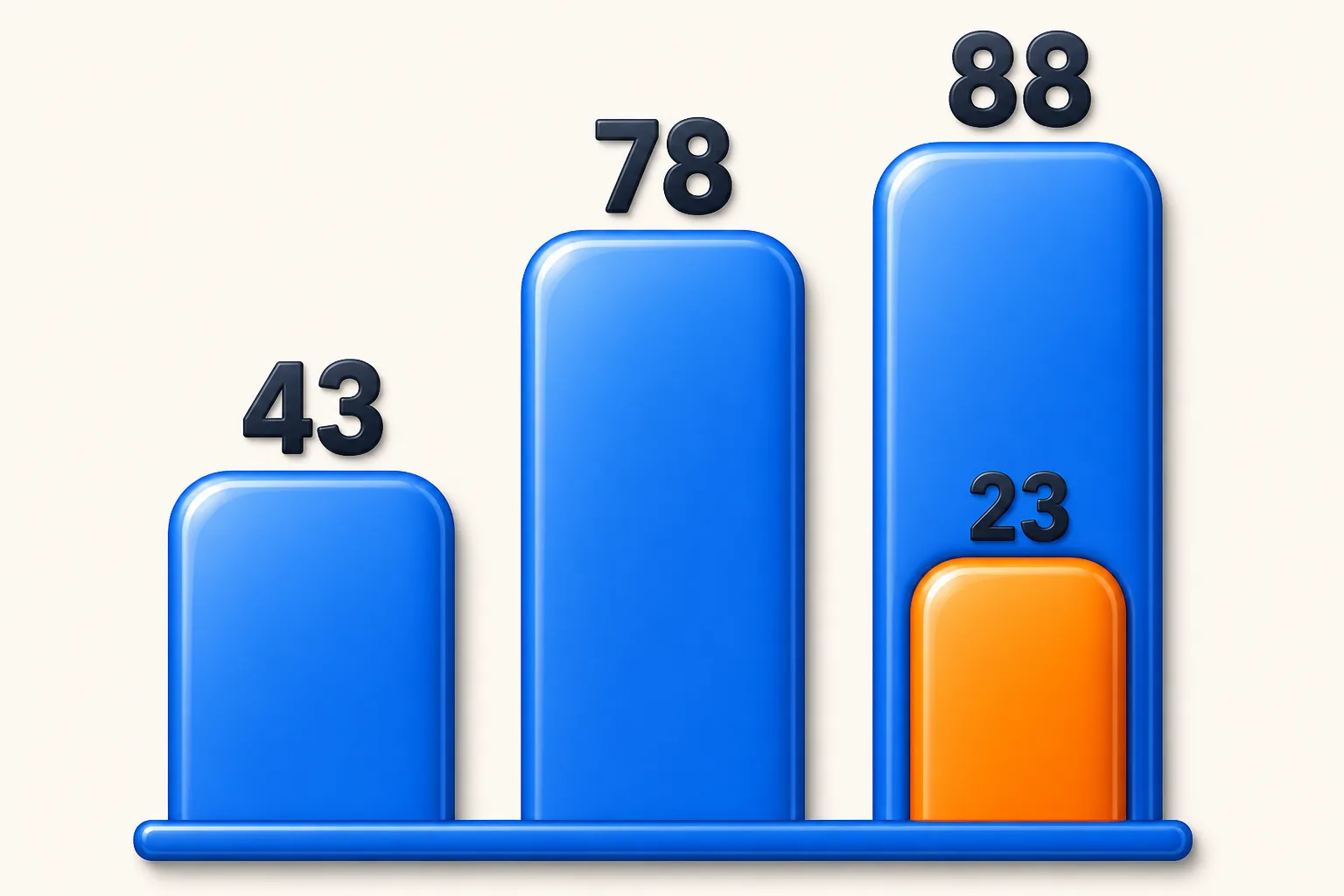
A one-person firm can use just 43 of the catalog's 101 tools. A solo practitioner and a 40-person firm are not shopping the same market, and the difference is not mainly price. Widen to firms of 10 to 50 people and 88 tools fit, but below 10 staff, 23 tools in that group stop working: they assume a team exists to run them. 12 Best AI Tools for Accountants in 2026 covers the standout pick at each workflow stage; headcount growth changes which tools still work, and this guide covers that shift and routes you to the deeper guide for your bucket.
Most roundups sort tools by category or by price. Neither view answers the question a growing firm actually has, which is whether a tool will work at its size. Price is part of it, but the bigger constraint is the shape of the work: whether the firm runs a statutory audit, consolidates more than one entity, or has enough people to divide labor across a workflow the tool assumes already exists.
Why firm size gates categories, not just seats
The 23 tools in CurateSuite's catalog that fit only mid-size firms (10 to 50 staff) cluster hard into three jobs a solo or small practice rarely has: audit and controls work (FloQast, MindBridge, Trullion, Circit, Kira, Trintech, Validis), FP&A and consolidation (Planful, Vena, Cube), and enterprise-grade ledgers built for multiple entities and currencies (NetSuite, Sage Intacct, Campfire, DualEntry). A handful more, including Workiva for regulated reporting and high-volume payments platforms like Tipalti and Vic.ai, round out the list.
None of that is arbitrary. Audit and controls tools assume a second reviewer checks what the AI flags, which requires a review layer a one-person firm does not have. FP&A platforms assume a budgeting cycle and multiple business units to consolidate. Enterprise ledgers like NetSuite are priced and built for firms running several entities and currencies at once, a problem a five-client bookkeeping practice never faces. Buy any of these too early and the tool sits mostly idle. Buy the equivalent solo-scale tool too late and the team drowns in manual work the AI could already be doing.
The opposite end of the catalog has its own gate. Thirteen tools, including Wave Accounting, FreshBooks, and Puzzle, work well for solo and small practices but stop scaling before mid-size: usually because their pricing model or feature set assumes a single owner-operator rather than a distributed team with role-based permissions.
At one person, the job is speed: a ledger and a document-capture tool are usually the whole stack, because there is no team to coordinate. QuickBooks Online plus Dext covers most solo practices for under $90 a month total, and neither charges for features a one-person firm cannot use anyway.
Add a second or third person and the bottleneck moves from data entry to coordination. This is where practice-management tools like Karbon earn their cost: at $59 per user per month, Karbon pulls client work out of individual inboxes and into a shared queue, which only matters once more than one person needs to see the same client's status.
Past ten people, the constraint changes again. The firm has enough transaction volume and enough staff to justify a controlled month-end close, and often enough regulatory exposure to need audit-grade evidence trails. That is the point where FloQast-style close management and consolidation tools like Datarails start to pay for themselves, because the review and reporting volume finally justifies the per-seat spend.
If you work alone
Start with the solo practitioner guide, which covers the four tool categories that actually matter at this scale and a rollout path across three budget tiers. Of the 43 tools built for a one-person firm, the ones worth knowing by name are a cloud ledger, a document-capture tool, and a tax research subscription. Everything else, including workflow software and FP&A platforms, is built to coordinate a team that does not exist yet.
If you're a small firm
If the firm has grown past one person but still runs without a dedicated IT or admin function, the small US firm guide organizes tool picks by whether the firm's work is mostly tax prep, bookkeeping, or advisory, since those three work mixes need different stacks even at the same headcount. Seventy-eight tools in the catalog fit this range, more than double the solo count, because the moment a firm adds staff it also adds coordination problems that unlock a whole category (practice management) that solo firms skip entirely.
If you're scaling into mid-size (10 to 50 staff)
A firm crossing ten people usually still runs the same core ledger and document-capture tools it bought at a smaller size. What changes is what gets added on top: close management, audit-grade evidence collection, and multi-entity or FP&A tooling that would have been overkill five people ago. A CurateSuite guide dedicated to this exact bracket is in production as part of this series; until it publishes, the categories above (close, audit and risk, FP&A) are the ones to start pricing out, and the tool directory lets you filter to mid-size fit directly.
A three-question filter for picking your bucket
- How many people touch client work day to day? One means the solo guide. Two to nine usually means the small-firm guide. Ten to fifty means you are in mid-size territory even before you buy anything new.
- Does the firm run a statutory audit, consolidate more than one entity, or carry SOX-type compliance obligations? A yes here pulls a five-person firm into mid-size tool territory for that one job, even though the rest of its stack stays small-firm sized.
- Is there anyone dedicated to onboarding and administering software, or does every tool have to be self-serve? Self-serve firms should stay with tools built for solo and small use regardless of headcount, since mid-size tools assume someone can spend real hours on setup.
Headcount answers the first question. The second and third questions are why a lean eight-person audit shop and a lean eight-person bookkeeping practice end up buying almost nothing from the same list, despite being the same size on paper.
Once you know your bucket, the picks above narrow the field but do not replace due diligence on the finalists. How to Evaluate AI Accounting Software: A 5-Point Framework walks through the five questions worth asking before signing with any specific vendor. If you would rather skip the reading and get a shortlist directly, the CurateSuite matchmaker takes about a minute and does not ask for an email address.
Common questions
Is a 50-person firm still considered mid-size?
In this framework, yes. The 10 to 50 range is wide because the gating factor is usually whether the firm has a dedicated review layer and enough transaction volume to justify close and audit tooling, not the exact headcount. A 45-person firm and a 12-person firm often buy from the same shortlist.
What if my firm has only five people but does audit work?
Headcount alone would put a five-person firm in the small-firm bucket, but the work itself pulls specific categories, mainly audit evidence and controls tools, into mid-size territory. Buy those categories from the mid-size list and keep the rest of the stack sized for a small firm.
Do solo practitioners just need cheaper versions of the same tools?
No. Thirteen tools in the catalog are built for solo and small firms specifically and are not scaled-down mid-size products; they are designed around a single owner-operator from the start, with pricing and features to match. A mid-size tool's entry tier is usually not the right substitute.
Will CurateSuite publish separate guides for bookkeepers, partners, and mid-size firms specifically?
Yes. This firm-size cluster is being built out with dedicated guides for mid-size firms (10 to 50 staff), bookkeepers, and firm partners and managers, each linked from here once published.


