CurateSuite
Guide9 min read

Build vs Buy: Custom AI or Off-the-Shelf Tools for Your Firm?

Most build-vs-buy debates skip the real question: is your bottleneck common enough that a vendor already solved it. A four-question rubric for AI at accounting firms, and where custom builds quietly cost more than they save.

By CurateSuite
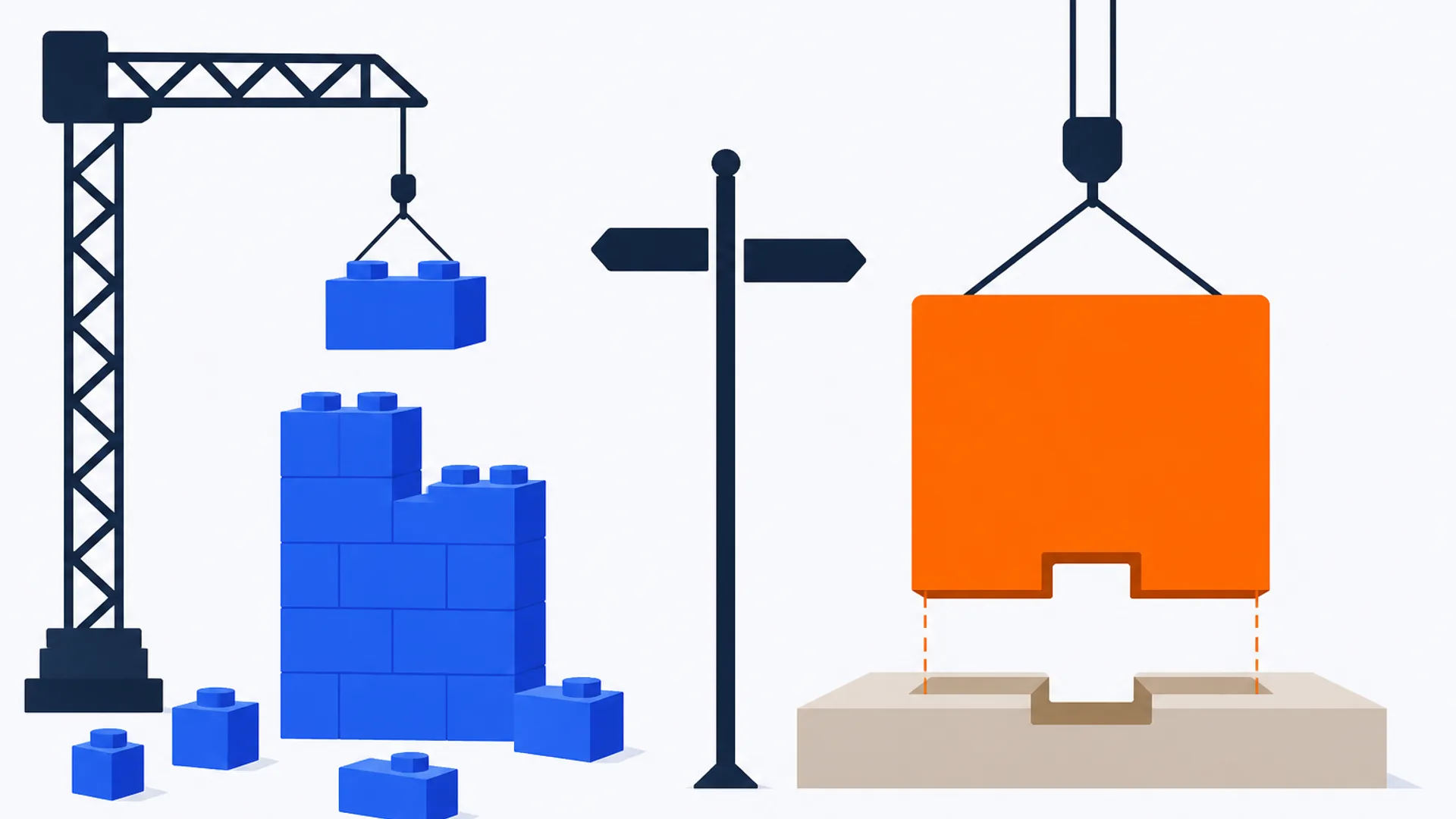
Flat editorial illustration, eye-level split-screen diptych on a warm off-white background: on the left, a deep-slate tower crane lowers a single brand-blue building block onto a half-built tower of stacked blue blocks, with loose blocks scattered at its base. On the right, a large brand-orange ready-made panel hangs from a crane hook and lowers whole toward a notched slot on a matching platform, with no loose pieces around it. A deep-slate signpost with two blank double-ended arms stands at the seam between the two halves. No desk, laptop, phone, document tray, or coffee cup in the scene.

"Build vs buy" sounds like a strategy question. For most accounting firms it is really a capacity question wearing a strategy costume. The honest version is: does your firm have someone who can maintain custom software for years, not just build a first version, and is your bottleneck rare enough that no vendor has already solved it and put a price on the shelf. Answer those two questions honestly and the decision mostly makes itself.

This guide is the rubric we point firms to when a build option comes up during tool evaluation, plus the specific failure pattern that turns a promising custom build into a maintenance burden nobody budgeted for.

What "build" actually means, because the term covers three different things

"Build" gets used for three different projects with three very different risk profiles, and conflating them is where most of this debate goes wrong.

The first is a prompt or a script: a partner wires up a spreadsheet macro or a ChatGPT prompt template that reformats client data a specific way. Low cost, low risk, and it breaks quietly the day the file format changes, which is usually fine because nobody is depending on it for client deliverables.

The second is an internal tool: a firm hires a developer, or has one on staff already, to build a piece of software against the firm's ledger data, its client list, or its workflow. This is a real engineering project with a real maintenance cost, even if the first version takes a weekend.

The third is a custom-configured platform: a vendor's enterprise product, built on their infrastructure but configured specifically for your firm. Datarails, priced per deal rather than published, is close to this category. It looks like "buy" on the invoice but carries some of "build's" configuration and onboarding weight.

The rest of this guide is about the second category, because that is where firms genuinely have a live choice. The first is not a real build decision, and the third is a vendor negotiation, not a build.

The four-question rubric

Four questions, asked in order, separate a build that pays off from one that quietly drains the firm for years.

1. Is this problem specific to your firm, or is it common across the industry? If ten other firms your size have the same bottleneck, somebody has almost certainly already built and sold a solution to it, usually cheaper and more reliably than a first build will be. Document capture, bank reconciliation, and workflow tracking are common enough that dozens of vendors compete on them. A workflow that only exists because of one unusual client relationship or one legacy system nobody else runs is a better build candidate, because no vendor has a reason to build it for you.

2. Do you have engineering capacity that continues after launch, not just budget for the first version? A custom tool needs someone to fix it when a ledger vendor changes an API, when a browser update breaks a scraper, or when the one person who understood the code leaves the firm. A firm with no ongoing developer relationship is not choosing "build", it is choosing "build once, then run unmaintained software until it breaks in a way that costs more than buying would have."

3. What does this cost over three years, not what does the first version cost? The build quote almost always covers development. It rarely covers the maintenance, the security patching, the hosting, and the redevelopment when the underlying AI model changes enough that prompts stop behaving the way they did on day one. AI Accounting Tools Pricing Compared breaks down how off-the-shelf tools price by seat, by client, or by usage. Run the same three-year math against a build before comparing the two, because a subscription's sticker price and a build's total cost of ownership are not the same kind of number.

4. What happens when the model or the API underneath it changes? Off-the-shelf vendors absorb this risk for you. When the underlying AI provider updates a model, a mature vendor tests it, adjusts its own prompts and guardrails, and ships the fix. A custom build has no one doing that work unless your firm is doing it, which loops back to question two. Firms that build once and never revisit the code end up running on a frozen, aging model version while every off-the-shelf competitor keeps moving.

Where buy wins for almost every firm

For the workflows that show up in every accounting firm's day, off-the-shelf almost always wins on cost, reliability, and speed to value. Document capture and data entry are the clearest case: a tool like Dext has processed enough invoices and receipts across enough firms that its extraction accuracy reflects real scale, something a first custom build cannot match without years of the same volume. Workflow and client management is similar. Karbon has already solved job tracking, deadline management, and team assignment in ways that took years of firm feedback to refine, and a firm rebuilding that from scratch is re-solving a problem that is not specific to them at all.

Reporting is the same story. A tool like Fathom turns ledger data into client-ready reports without a firm needing to maintain the connectors, the chart logic, or the export formatting that changes every time a ledger vendor updates its interface. That maintenance burden is exactly what a firm is buying its way out of with a subscription. If budget is the concern rather than capability, Free AI Tools for Accountants Worth Using in 2026 is worth checking before a build gets seriously considered, since several genuinely useful tools have no-cost tiers that cover a firm's first attempt at automating a task.

Where build can genuinely make sense

Build earns a real look in a narrower set of cases. A firm with an unusual data pipeline, several disconnected systems that no off-the-shelf tool bridges cleanly, is one. A firm that already employs a developer for another reason, so the marginal cost of a new internal tool is lower than it would be for a firm hiring one specifically for this project, is another. And a firm running a workflow specific enough that no vendor has built for it, and unusual enough that it likely never will, is the clearest case of all.

Even in those cases, scope the build narrowly. A small internal tool that does one specific job well is a very different maintenance commitment from an attempt to replicate what a mature vendor product already does across dozens of features.

The hidden cost that kills most custom builds

The build that fails is rarely the one that could not be coded. It is the one where the maintenance plan was never written down. A developer builds a working tool, the firm uses it for a year, and then the ledger vendor changes its API, or the one person who understood the code takes a new job, or the underlying AI model gets deprecated. Nobody owns the fix, because nobody was assigned to own it past the launch date.

Before starting a build, write down who maintains it in year two and year three, and what the plan is if that person leaves the firm. If there is no answer to that question, the honest conclusion is that the firm is choosing an unmaintained tool with a delay built in, not really choosing "build" over "buy" at all.

Applying the rubric

A firm considering a build to automate client onboarding runs the four questions. Is the problem common? Yes, onboarding is a near-universal bottleneck, and several vendors already compete on it. Is there ongoing engineering capacity? No, the firm has no developer relationship beyond the original build quote. What is the three-year cost? The vendor option runs a known monthly fee; the build's true cost, once maintenance and eventual redevelopment are added, comes out close to the same number with none of the vendor's ongoing improvements included. What happens when the model changes? Nobody at the firm would notice until client intake started producing errors.

Three of the four answers point to buy. That is not a coincidence. Most firms asking this question about a common workflow land on buy once the maintenance question gets asked honestly, rather than skipped in favor of the first version's price tag.

The shortcut

If the rubric points toward buy and the next question is which tool, the CurateSuite matchmaker matches a firm's size, budget, and workflow against the current tool landscape in a few questions and returns a shortlist without a sales call. It is free and does not require an email address to see the results.

Common questions

Is using ChatGPT or a custom GPT prompt the same as building custom AI software?

No, and treating them the same is where a lot of this debate goes wrong. A prompt template a partner writes for a specific task is closer to a personal workaround than a software project. It has almost no ongoing cost, but also almost no reliability guarantee, and it is not a substitute for either a proper custom build or an off-the-shelf tool for anything client-facing or repeatable at scale.

How much does a custom AI tool typically cost to build for a small firm?

It varies too widely by scope to give one number, but the first version is rarely the real cost. A narrow internal tool built by a freelance developer can run from a few thousand dollars up, and that figure almost never includes the ongoing maintenance, hosting, and eventual rebuild that keeps the tool working past year one. Compare that full multi-year figure against an off-the-shelf subscription before deciding, not just the initial invoice.

What is the biggest risk in choosing to build instead of buy?

Losing the one person who understands the system. Off-the-shelf vendors spread that knowledge across a team and a support function. A firm's custom build usually depends on one developer's memory of decisions made months or years earlier, and when that person leaves, the firm is often left with software nobody can safely change.

Can a firm switch from a custom build to an off-the-shelf tool later?

Usually yes, and it is a more common path than the reverse. The main cost is exporting whatever client data lives in the custom system into a format the new tool can use. Firms considering a build purely to avoid a subscription fee should weigh that against the fact that most vendors make onboarding from a spreadsheet or a simple export straightforward, which narrows the advantage a custom system holds.

Does build vs buy apply differently to a solo practitioner than a larger firm?

The logic holds, but the answer shifts further toward buy. A solo practitioner rarely has spare engineering capacity or the client volume to justify a build's fixed cost, so questions two and three in the rubric tend to resolve against building almost automatically. The narrow build cases described above mostly assume a firm with more scale or an existing developer relationship, neither of which is typical for a one-person practice.

Most firms that run this rubric honestly end up buying. That is not a bias in the framework, it is a reflection of how much of accounting work is common enough that someone else has already built and priced the fix.

Find the right AI tools for your firm

Seven questions, two minutes, a short list of the five tools that fit your firm best. Your results, instantly. No sign-up needed.

Take the matchmaker

Tools referenced in this article

More articles

Last updated 2026-08-20. Tool comparisons are based on vendor-published specs. See our methodology.