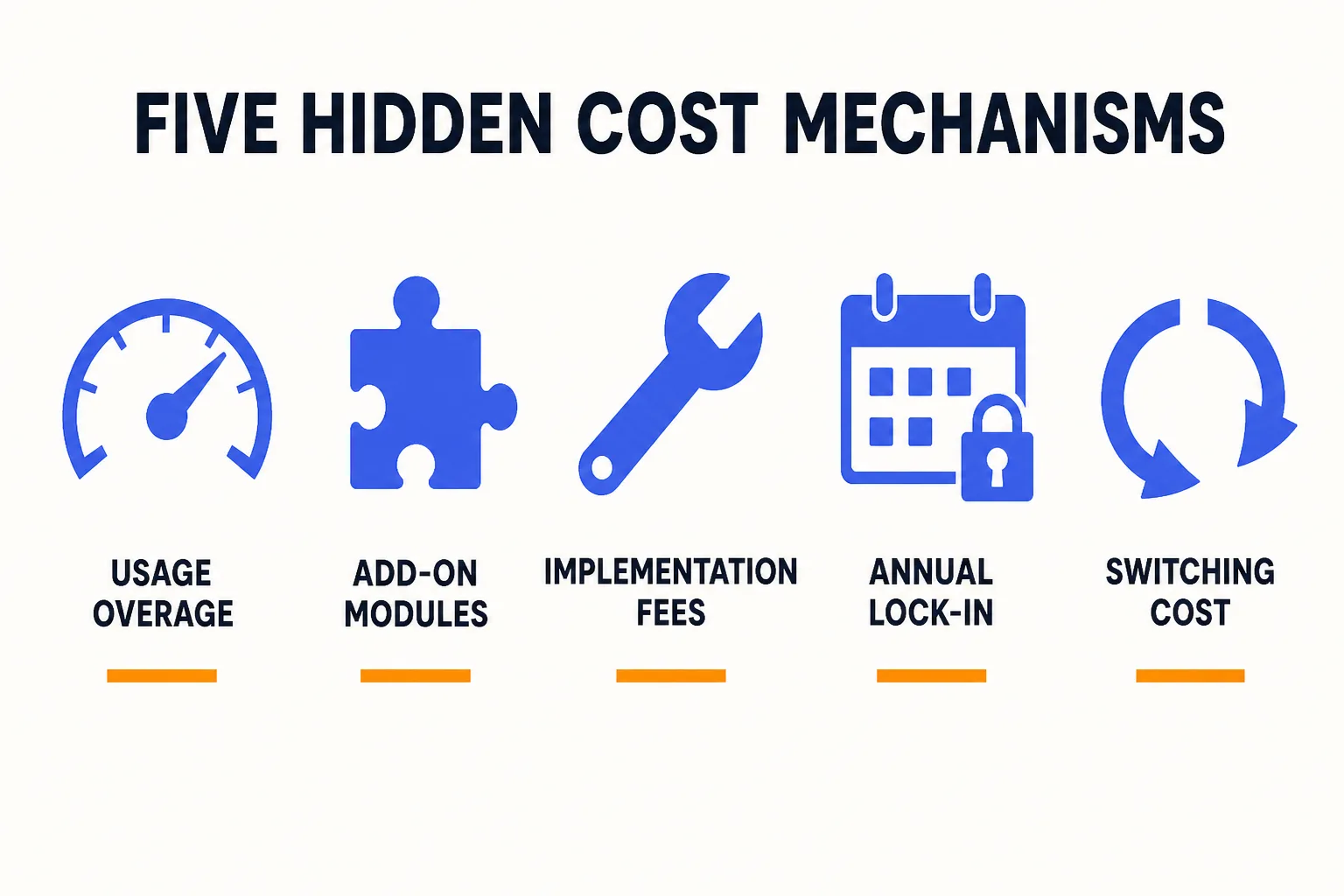
A sticker price is one number. The real first-year cost of an AI accounting tool is usually built from several, and most of them are not on the pricing page at all. Working through CurateSuite's catalog of AI accounting tools turns up five specific mechanisms that separate the quoted price from the invoice a firm actually pays: usage caps that convert to a per-unit meter once a client grows, add-on modules that turn a "core" plan into three separate purchases, implementation fees layered on top of the license, annual contracts signed with no trial period to test first, and switching costs that only become visible on the way out. Each shows up in named products with real numbers attached, not as a vague caution to "check the fine print."
The five-question evaluation framework puts true cost as question three for exactly this reason: the number on a vendor's homepage and the number on next January's invoice are rarely the same, and the gap is predictable once you know where to look.
Usage caps that turn into a per-unit meter
A price built around "up to X" is a price with a second number hiding behind it, and that second number often has no ceiling.
Fathom's Silver plan is $315 a month for up to 10 companies, a rate of $31.50 per entity. Add an eleventh client and the marginal cost is $31, roughly the same as the blended rate baked into the plan itself, with no volume discount for the extra seat. Eazycapture includes 250 documents per client per month before billing roughly GBP 0.15 per extra document, fine for a lean client but a real add-on for a document-heavy one. Veryfi's Starter plan carries a $500-a-month minimum commitment and charges per document from the first one, $0.08 for receipts, $0.16 for invoices, and $0.25 for checks and statements, so roughly 5,000 documents a month is what the minimum works out to at blended rates. Vinyl prices its meeting-notes tiers by hours of recording a month, and every tier past Starter carries its own per-minute overage rate once the included hours run out.
None of these are hidden in the sense of being undisclosed. They are published, usually in the plan's fine print rather than the headline number. What makes them a real budgeting risk is that the number a firm sees in the demo (10 companies, 250 documents, a set number of hours) is a snapshot of usage on the day of the demo, not a forecast of usage twelve months later when the client roster or the document volume has grown past it.
Add-on modules that turn one plan into three
A second mechanism shows up in how vendors structure "core" versus "extra." Silverfin prices its Hub platform per client file, billed annually on a quarterly cycle, and that covers the base working-paper and collaboration layer. Accounts production, corporation tax, and management accounts are separate add-on modules, each billed per file on top of the Hub. A firm quoting Silverfin off the Hub price alone is quoting only the base platform: accounts production, corporation tax, and management accounts are priced separately per file on top of it. Stampli runs the same pattern from the AP side: the core platform covers invoice approval and unlimited entities, while procurement, direct payments, and a company card are each a separate add-on module priced apart from the base subscription.
Neither vendor is doing anything unusual for enterprise software. The issue is timing: a demo built around the core plan's feature list can leave a buyer assuming those adjacent modules are included, and the gap only surfaces once a specific workflow (tax prep, a procurement step, a card program) turns out to sit behind a second quote.
Implementation fees that dwarf the license number
For the custom-quote end of the catalog, the license fee is often the smaller line item. Sage Intacct is priced per user and per module by a sales team, with implementation fees layered on top of the negotiated license, and there is no free trial to size that cost before committing. CaseWare is similar: per-seat, annual-contract pricing quoted on application, sized by team size, modules, and how much onboarding work the rollout needs, and CaseWare's own guidance treats annual price increases at renewal as a known feature of the product rather than a surprise to negotiate away. Mid-market platforms like Vena and Planful both quote first-year deployments running into the tens of thousands of dollars once user roles, modules, and rollout time are priced in, again with no published number and no trial to check the estimate against.
The pattern across all four: the software license is the part of the quote that gets negotiated hardest, while the implementation and onboarding line, the part that actually determines how many weeks pass before the tool does anything useful, gets far less scrutiny before signing.
Annual contracts with no trial to test first
A meaningful share of the catalog asks a firm to commit before it can try the product at all. Karbon, Planful, Vena, Laurel, NetSuite, Campfire, and Soraban all bill on annual contracts with no free trial offered. Aider adds a specific floor to that pattern: a $150 monthly minimum plus a twelve-month commitment, which needs roughly fifteen clients on the platform before the per-client rate starts to feel like the bargain the headline price implies. Silverfin carries a minimum file count across the platform on top of the annual, quarterly-billed structure.
None of this makes annual-only pricing a bad deal on its own; enterprise software has priced this way for decades, and a firm that has already run a structured evaluation (ledger fit, workflow fit, a real reference call) is buying with open eyes. The risk is specific to a firm that skips straight from demo to signature: a twelve-month commitment with no trial period converts a bad fit from a minor inconvenience into a year-long one.
The switching cost nobody prices before you sign
The last mechanism is not a fee at all. It is what a tool costs to leave. Zeni works exclusively with QuickBooks Online Plus, so a firm running Xero has to migrate its ledger before Zeni is even an option, and the reverse holds for firms already committed to QuickBooks Online: moving to a Xero-based stack later rarely pays back the migration effort. Neither vendor prices this. It shows up only when a firm's client base, or its own ledger preference, shifts after the contract is already signed.
Switching cost is the mechanism most easily missed in a demo, because a demo is built to show what the tool does on day one, not what it takes to unwind three years of client mappings, custom fields, and integration history on the way out. It belongs in the evaluation before signing, not after.
What to ask before you sign
Five questions, matched to the five mechanisms above, turn this from a post-signing surprise into a pre-signing checklist:
- What is the included usage limit (entities, documents, hours, transactions), and what is the exact per-unit rate past it?
- Which features sit in the base plan versus a paid add-on module, in writing, not from memory of the demo?
- Is there an implementation or onboarding fee separate from the license, and what is the estimated timeline it covers?
- Is there a free trial or a short-term pilot, or does the first checkpoint on cost only arrive at the twelve-month renewal?
- What does data export look like on the way out, and does the ledger or workflow this tool sits on create a real switching cost later?
AI Accounting Tools Pricing Compared breaks down how the catalog's 101 tools structure their base pricing model, per user, per entity, per transaction, flat, or custom quote, which is the layer underneath these five mechanisms. If the budget is tight enough that avoiding hidden costs matters more than any other feature, Free AI Tools for Accountants Worth Using in 2026 covers the dozen tools in the catalog with a genuine free tier rather than a time-limited trial.
Common questions
Usually yes, but not on the page a buyer reads first. Overage rates, add-on module pricing, and implementation fees are typically published somewhere, a plan comparison table, a terms page, a sales quote, rather than concealed outright. The cost shows up because a demo highlights the headline plan and leaves the fine print for later, not because the vendor hides it entirely.
Which pricing structure carries the most hidden-cost risk?
Usage-based caps carry a real risk because the plan's per-unit rate typically holds flat past the included limit rather than getting cheaper with scale, as with Fathom's $31-per-additional-entity rate against its $31.50-per-entity blended Silver plan. Per-entity and per-client pricing carries a related risk: the bill rises with client count even when headcount does not change.
How can a firm estimate the real first-year cost before signing?
Request a written quote for the exact configuration expected at the twelve-month mark, not the day-one configuration, including every add-on module the workflow will actually need and any implementation fee. For custom-quote tools, ask the vendor to name the specific variable that drives price (seats, entities, transaction volume) and quote both today's number and next year's.
Not on their own. Several established platforms in the catalog price this way and deliver real value once installed. The risk is specific to skipping evaluation: a twelve-month commitment signed straight after a single demo, with no trial and no reference call, turns any mismatch into a year-long one instead of a two-week one.
What is the single most overlooked hidden cost?
Switching cost. A vendor's pricing page covers what a tool costs to run, never what it costs to leave, and that number only becomes visible when a firm's ledger, workflow, or client base has already grown around the tool it now wants to replace.
Running the five-question checklist above against a live shortlist takes time by hand. The CurateSuite matchmaker asks a few questions about firm size, budget, and workflow and returns the tools that fit, with results shown immediately and no email required.


