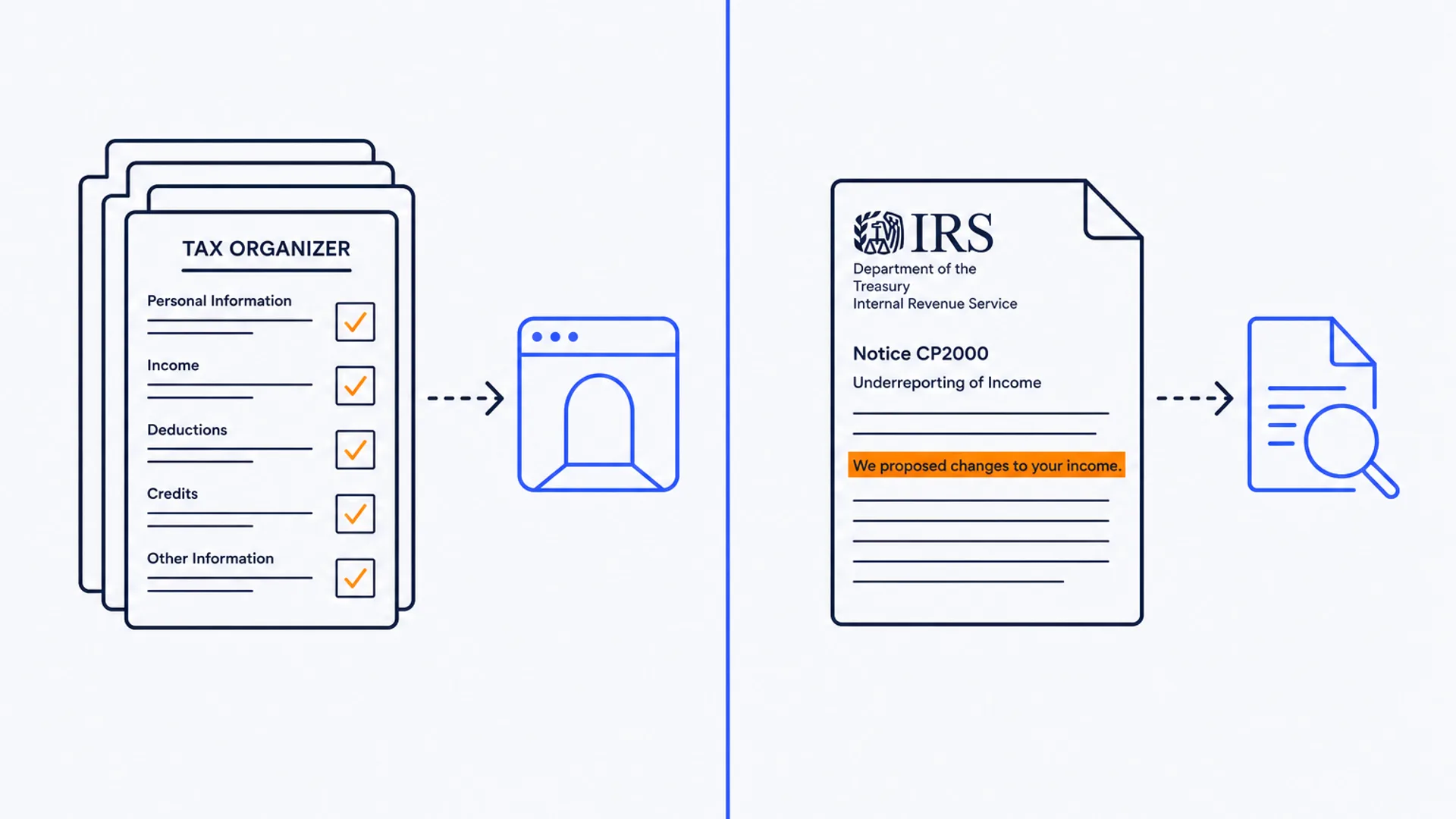
TaxDome and Canopy both get pitched as the one platform that replaces a firm's separate CRM, portal, billing, and document tools, and both show up on nearly every shortlist for practice management software. Past that shared pitch, the two are built for different jobs. TaxDome runs pre-filing tax organizers inside a branded portal and bills annually with no free trial. Canopy runs IRS transcript pulls and notice tracking for resolution work and bills monthly with a trial, but only inside the United States.
That split matters more than either vendor's feature list. A firm that picks based on price per seat alone can end up locked into a year of TaxDome with a client base outside the US, or paying Canopy's monthly rate for IRS integrations a bookkeeping-heavy practice never touches. This guide works from a three-question filter, geography, the shape of the tax work, and how much commitment risk the firm can absorb, rather than a side-by-side score that treats the two as substitutes.
The short answer
- US tax-prep firms sending clients pre-filing questionnaires: TaxDome's tax organizers move that back-and-forth into a structured form inside the portal, and templates arrive pre-built for 1040, 1120, and 1065 season.
- US tax firms doing resolution work, audit support, or heavy IRS notice handling: Canopy's direct IRS transcript pulls and notice tracking are the deeper feature here, and the Tax Resolution module is built around exactly that correspondence.
- Firms with any clients outside the United States: TaxDome only. Canopy's geo-availability stops at the US border; TaxDome covers the US, UK, Australia, Canada, and Europe.
- Firms that want to trial before signing a year of software: Canopy offers a free trial. TaxDome does not, and its pricing is billed annually upfront.
The three-question filter
1. Does every client sit inside the United States?
This narrows the field before anything else does. Canopy's geo-availability is US only, full stop, so a firm with even one client outside the country is choosing between running a second tool for that client or ruling Canopy out entirely. TaxDome lists the US, UK, Australia, Canada, Europe, and beyond, and ships in thirteen languages, which makes it the only one of the two that works as a single platform for a firm with any international client mix.
2. Is the work mostly pre-filing prep or ongoing IRS resolution?
TaxDome's workflow templates ship pre-configured for tax-return season, and its built-in tax organizers replace the email chase for prior-year documents with a form the client fills out inside the portal. That is the strongest reason a prep-heavy firm picks TaxDome over the alternative. Canopy's edge sits on the other side of the filing deadline: direct IRS transcript pulls, notice tracking, and e-Services integration where available, aimed at the correspondence that follows a return, not the collection that precedes it. A firm whose staff spend more hours chasing missing 1099s than responding to CP notices is solving a different problem than a firm doing the reverse.
3. How much annual commitment can the firm absorb before knowing if it works?
TaxDome charges per user per year with no free trial, so a firm signs a year of software before running a single real season through it. Canopy bills per user per month on an annual contract but offers a free trial, which gives a firm a way to test the workflow against an actual client file before committing budget. For a firm that has already run TaxDome or Canopy at a previous job, or gets a strong reference from another practice, that gap matters less. For a firm evaluating either platform cold, it is the difference between a demo and a real trial run.
TaxDome: annual per-user pricing built around tax organizers
TaxDome consolidates client portal, workflow, document management, e-signatures, and billing into one system, with tax organizers as the standout feature: pre-filing questionnaires that clients complete inside the portal instead of over email. That structured intake is where the time savings show up for a tax-heavy practice, more than any AI feature on the platform.
Pricing runs Essentials at $800 per user per year for a single-user firm, Pro at $1,000 per user per year (or $100 per seat per month if billed monthly), and Business at $1,200 per user per year, adding custom roles, advanced reporting, and priority support. There is no free trial and no free tier, and billing is annual upfront across every plan except the monthly option on Pro. AI features lean toward document handling: classification of client uploads, extracted fields from W-2s, 1099s, and K-1s, reply suggestions on client messages, and flags for a document a returning client uploaded last year but has not uploaded this year.
TaxDome connects to QuickBooks, Xero, Zapier, Stripe, Gmail, and Outlook, and serves firms in the US, UK, Australia, Canada, and Europe. The trade-off for that international reach and organizer depth is the annual, no-trial commitment.
Canopy: monthly pricing with a free trial and deep IRS integrations
Canopy bundles a CRM, workflow, client portal, time tracking, billing, and AI features into one platform, with its strongest differentiator sitting in the IRS integration layer rather than the client-facing portal. Direct IRS transcript pulls, notice tracking, and connections to Drake, ProConnect, UltraTax, and CCH ProSystem fx target firms whose work includes ongoing correspondence with the IRS, not just the return itself.
Pricing tiers run Standard at $74 per user per month, Plus at $109, and Premium at $149, all billed annually, plus a custom Enterprise tier. A free trial is available on the paid plans, which is the more forgiving on-ramp of the two platforms. AI features include summarizing long client email threads on demand, auto-creating tasks from inbound IRS notices, extracting key fields from transcripts and CP notices, and auto-filing documents into the right client folder.
Canopy connects to QuickBooks, Xero, FreshBooks, Gmail, Outlook, Slack, Zapier, Salesforce, and the major US tax-prep suites, but its geo-availability stops at the United States. A firm with even a handful of international clients needs a second tool for them regardless of how well Canopy fits the rest of the roster.