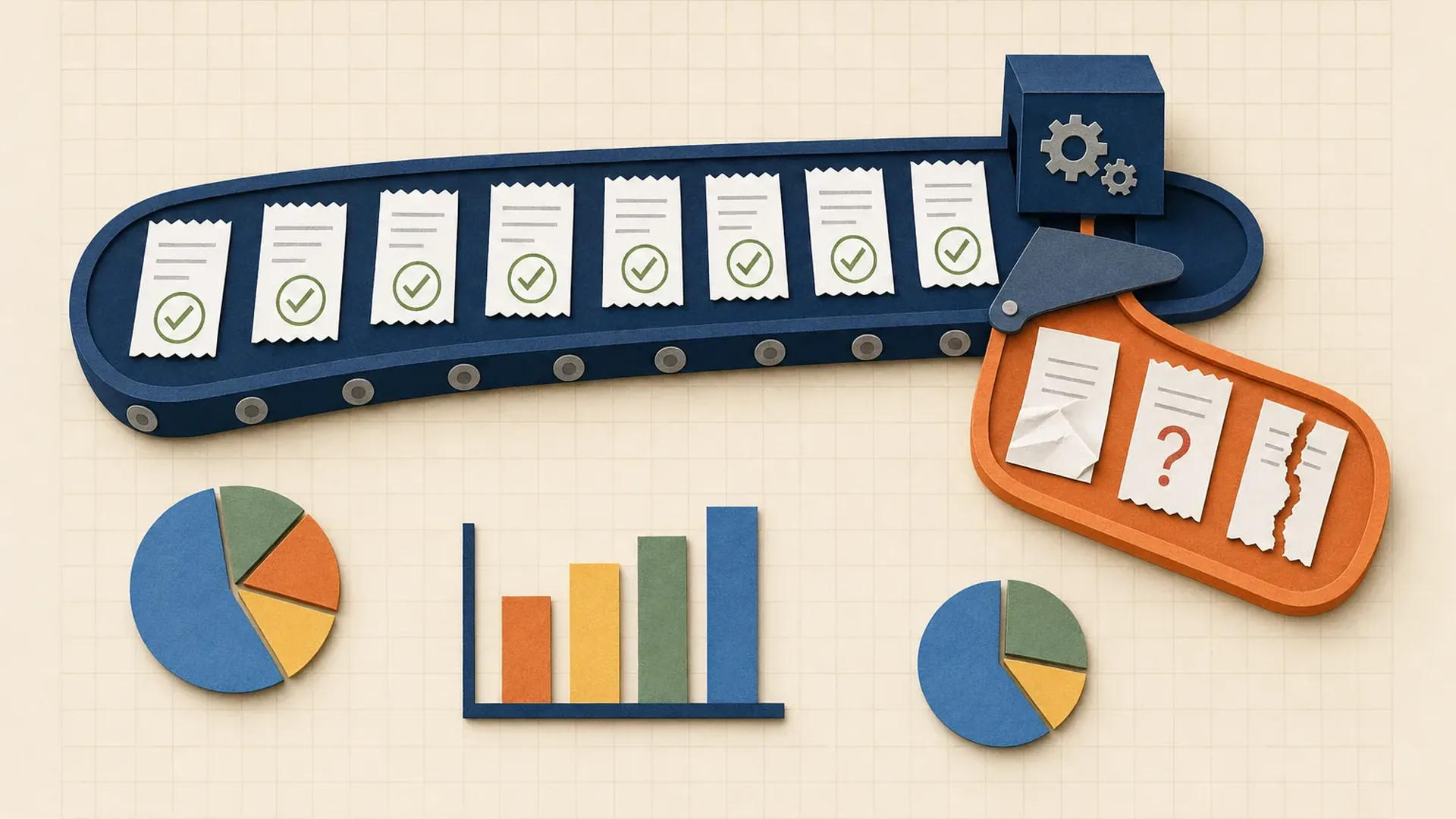
Ask five vendors what AI bookkeeping automates and you get five different answers, most of them vague. The useful question is not whether a tool uses AI. It is whether a specific task passes a three-part test: is the volume high, does the pattern repeat consistently, and is a wrong call cheap to catch and fix. Score a task on all three and today's tools already do it well. Fail even one, and no amount of AI marketing changes the fact that a person still has to do it.
That test, run against what the tools in our core ledger and bookkeeping catalog actually document, is what sorts the real automation from the parts of the job software still cannot touch. For a full walk-through of the tools themselves, the hub guide, best AI bookkeeping software in 2026, compares them on price and fit. This piece stays narrower: which tasks move, and which stay with the bookkeeper.
A three-question test for what AI can actually automate
Before the list, here is the test itself, because it explains why this article splits the way it does.
- Is the volume high? A task that repeats hundreds of times a month gives a model enough examples to learn from.
- Does it follow a consistent pattern? The same supplier, the same coding logic, the same shape of transaction, month after month.
- Is a wrong call cheap to catch and reverse? Miscoding a recurring expense gets caught at reconciliation. Missing a materiality problem in year-end financials does not.
A task that clears all three is a strong candidate for automation, and the vendor evidence below shows tools handling it well today. A task that fails even one, low volume, no repeatable pattern, or an expensive mistake, still needs a bookkeeper, no matter how the product is marketed.
What AI bookkeeping automates today
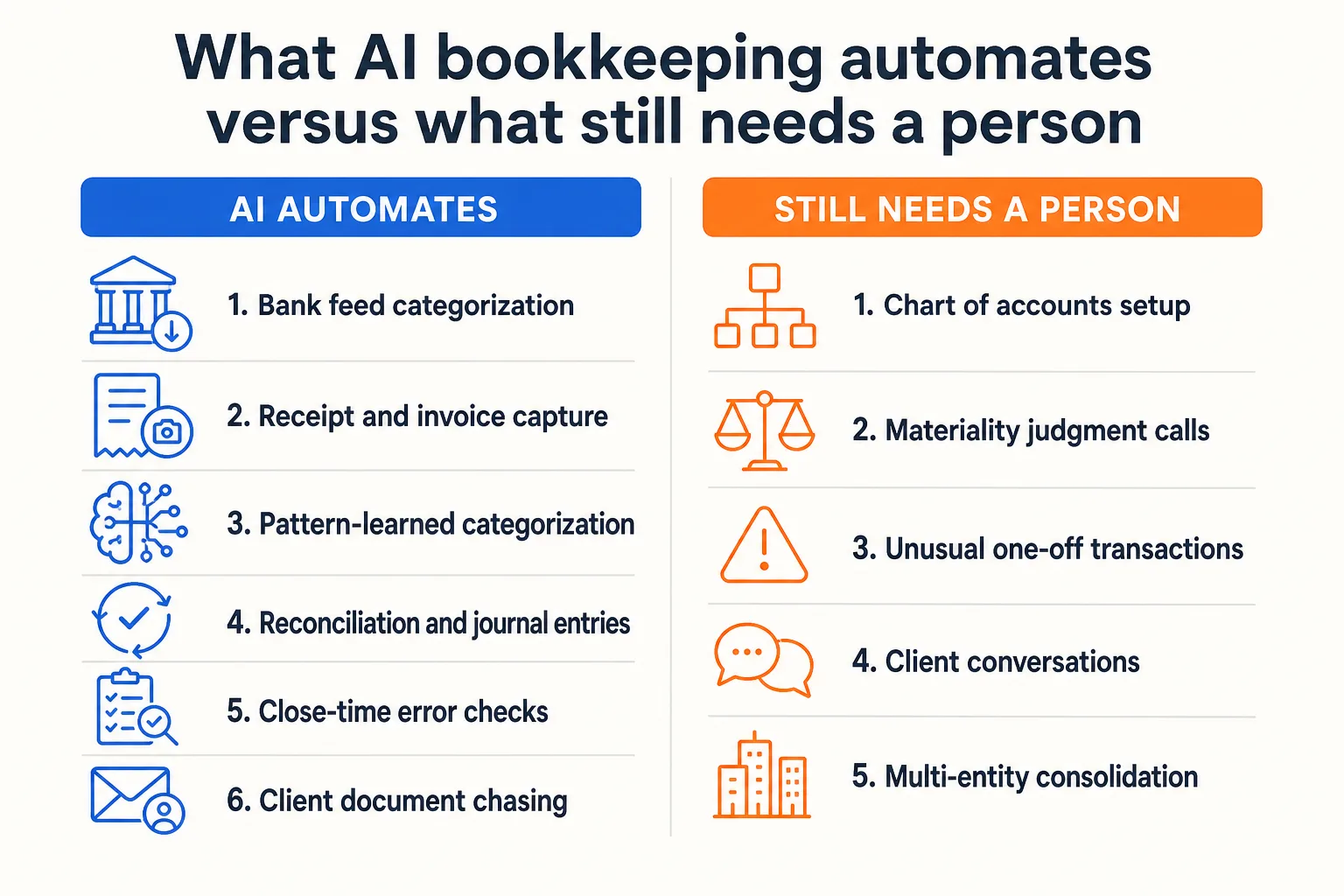
Six tasks clear the test, and the tools in our catalog show real depth on each one.
1. Bank feed categorization and matching
This is the highest-volume, most consistent task in the whole discipline, and it is also the most mature. QuickBooks Online and Xero both ship categorization that learns from a firm's past coding decisions and suggests matches against outstanding invoices, with anomaly detection flagging entries that break the pattern. Xero and QuickBooks both also ship separate natural-language assistants (Xero's "Just Ask" and Intuit Assist) for querying the books, distinct from the categorization engine itself. Neither costs extra on top of standard pricing, which tells you how settled this category already is.
2. Receipt and invoice capture
OCR-based capture is the other mature category, though accuracy still depends on the source document. Dext publishes its own range: 95% or higher on clean PDF invoices, 85% to 90% on photographed receipts, dropping below 80% on handwritten or complex multi-page documents. Hubdoc, included free with paid Xero plans, handles the same job at a lower price but with weaker extraction on complex line items, a real trade-off rather than a marketing gap. Both fit the test: high document volume, a repeatable extraction pattern, and a wrong field gets caught the moment a bookkeeper reviews the draft entry.
3. Pattern-learned categorization across a client's own history
Digits is worth calling out on its own, because it automates a layer above single-transaction categorization. Its Autonomous General Ledger checks a new transaction against the client's own posting history first, then, for firms on the partner program, the firm's history, then patterns learned across every Digits user. That is the volume-and-pattern test running up to three layers deep, with the exact layer count for non-partner firms not specified by the vendor, which is why it can post entries with very little manual input on repeat transactions.
4. Reconciliation and journal entry drafting
Truewind turns bank statements and workpapers into general-ledger-ready entries and reconciliations for the month-end close, and Botkeeper posts high-confidence entries straight to the ledger while routing anything under its confidence threshold to a person. Truewind is explicit that a human reviews and approves every entry before it posts; Botkeeper posts high-confidence entries automatically and routes only the rest to a person, a distinction that matters for the section below. For how that drafting step works across tools, see automated journal entries, and for the systems those entries post into, the best general ledger software for accounting firms.
5. Close-time error checking
Keeper, now branded as Double, sits on top of the ledger after the bookkeeping is done and runs automated checks: balances that have not moved when they should, lines miscoded against the firm's own rules, and gaps that bank reconciliation alone would miss. It is built for firms closing ten or more client books a month, which is itself a volume signal. Below that threshold, the pattern has not repeated often enough for the check to earn its subscription.
6. Chasing clients for missing documents
Booke spots a missing receipt or invoice and sends the request automatically. It is a smaller task than the others, but it is genuinely high volume (every client, every month) and low-risk if a reminder goes out slightly wrong, so it clears the bar easily.
Where AI bookkeeping still fails
The same test explains the tasks that stay with a person, because each one fails on volume, pattern, or the cost of a mistake.
1. Setting up a new client's chart of accounts
A chart of accounts is a one-time, low-volume decision that has to reflect how a specific business actually runs. There is no repeating pattern to learn from, because every client's structure is different, and a badly built chart quietly breaks every report built on top of it for years. No tool in the catalog claims to automate this step, and that absence is informative on its own.
2. Materiality judgment calls
Deciding whether a miscoded $400 line matters this month depends on the client's size, the account it landed in, and what else is happening in the business, context no vendor's product documentation claims to hold. This fails the pattern test, because every judgment call is shaped by circumstances that differ, and it fails the cost test, because a wrong call can mislead a client about their own numbers.
3. Unusual and one-off transactions
Refunds, partial payments, foreign-currency settlement timing, intercompany loans. These fail the pattern test by definition: a transaction that does not repeat gives a model nothing to learn from, so even the best categorization engine hands it to a person.
4. The client conversation
None of the automation above touches the "why is this bigger than last month" check-in that keeps a client engaged and, often, keeps the client. It is not a data task, so it does not clear the first question in the test at all.
5. Multi-entity and multi-currency consolidation for growing clients
This one is subtle: the vendors themselves gate it behind their more expensive tiers, which is a tell. Digits keeps multi-entity and multi-currency support inside its $250-per-month Pro tier rather than its $65 Essentials plan. QuickBooks Online's own guidance describes its multi-entity reporting as shallow for a single client running several subsidiaries, pointing firms toward Sage Intacct or NetSuite instead. When a vendor prices a capability higher or routes you to a different product entirely, that is the vendor saying the volume-and-pattern combination gets harder at that scale, not a settled part of the automation story yet.
Even the automated wins keep a human checkpoint
Worth being direct about something the six-item list above does not say outright: none of it runs unattended. Truewind states that a human reviews and approves every entry before it posts. Botkeeper posts only above a confidence threshold and routes the rest to a person by design. Dext's own accuracy figures top out at 95% on the cleanest input and fall well below 80% on messy input, which means a review step is built into the product rather than bolted on as an afterthought. Even the most automated tools in this catalog are architected around a checkpoint, because the vendors that build them know a wrong entry costs more than the minutes saved by skipping the check.
That is worth remembering the next time "hands-off AI bookkeeping" shows up in a sales pitch. The honest version of that pitch is fewer hours on the repetitive half of the job, not zero hours on the whole thing.
Applying the test to your own firm
Run any task you are considering handing to software through the same three questions. High volume, a repeatable pattern, and a cheap-to-catch mistake means buy the tool and expect it to work close to what the vendor claims. Low volume, no repeat pattern, or an expensive mistake means budget the time for a person, and treat any tool promising to remove it entirely with real skepticism.
For where each bucket of bookkeeping time actually goes, and which specific tool fits each one, AI bookkeeping tools compared walks through the workflow side in more depth. If you would rather skip the comparison and get a shortlist for your own firm's size and ledger, the matchmaker quiz does that in a few minutes.
Common questions
Does AI bookkeeping replace a bookkeeper?
No. It automates the high-volume, pattern-consistent parts of the job (categorization, reconciliation, receipt capture, close-time checks) and leaves the low-volume, judgment-heavy parts (chart of accounts, materiality calls, unusual transactions, client conversations) with a person. Every vendor cited in this piece builds a human review step into its automated tasks rather than removing the person entirely.
What bookkeeping tasks does AI handle best?
Bank feed categorization and matching, receipt and invoice OCR capture, and reconciliation drafting are the most mature, because they are high-volume, follow a consistent pattern, and a wrong call gets caught quickly at review. Close-time error checking and pattern-learned ledger categorization are close behind.
Why can't AI set up a chart of accounts?
Because it is a one-time decision specific to how a single business runs, not a repeating pattern a model can learn from. Every client's structure differs, and a badly built chart affects every report built on it afterward, which is exactly the kind of low-volume, high-cost task that stays with a person.
Is "hands-off AI bookkeeping" a realistic claim?
Not based on how the tools in this category are actually built. Truewind, Botkeeper, and Dext all describe a human review or confidence-threshold step inside their own automation, and the tools closing the most client books each month, such as Keeper, now Double, are built specifically to catch what the automated steps miss. The realistic claim is fewer hours on repetitive work, not zero review.
Does automation get harder for multi-entity or multi-currency clients?
Yes, and the vendors' own pricing shows it. Digits keeps multi-entity and multi-currency support inside its higher-priced Pro tier rather than its entry plan, and QuickBooks Online's own guidance points firms with true multi-entity consolidation needs toward Sage Intacct or NetSuite instead. When a vendor prices or routes a capability differently at scale, that is a signal the automation is less settled there.