
CurateSuite
List9 min read

Best AI Bookkeeping Software in 2026

The best AI bookkeeping software in 2026, sorted by pricing structure rather than headline price, because per-entity pricing changes the real cost for a firm running many client files.

By CurateSuite
Eye-level view inside a small accounting office in warm morning light: a bookkeeper in a muted-blue shirt reviews auto-categorized transactions on a laptop while a second screen shows a live profit-and-loss chart, a coffee mug and a tidy stack of labeled client folders on the light oak desk

The headline price on an AI bookkeeping tool tells you almost nothing until you know how it scales. Across the 20 tools in our core ledger and bookkeeping catalog, the number that decides real cost for an accounting firm is not the $25 or $65 on the pricing page. It is whether that figure is charged per business, charged once for the whole firm, or quoted only after a sales call. Sort the market that way and the cheapest-looking tool for a single business is often the most expensive one for a firm running thirty client files.

That is the lens this list uses. If you are picking software for one company, jump to the picks for a single business. If you run books for many clients, the pricing structure is the first thing to check, before any feature. For a fuller look at where bookkeeping time actually goes and which category of tool shrinks it, the hub guide, AI bookkeeping tools compared, covers the workflow side.

How these picks are chosen

Every claim here comes from vendor pricing pages and product documentation for the tools in our catalog, checked against what each vendor publishes. We do not trial or hands-on test software. What we can do, and what a generic roundup usually skips, is line up the whole category on the same specifications and read the patterns that fall out.

The 20 tools split into two rough groups. Some are established ledgers that added AI to an existing product: QuickBooks Online, Xero, Zoho Books, FreeAgent, Clear Books. Others are AI-native, built from the ledger up around automatic categorization: Digits, Puzzle, Kick, Truewind, Zeni, Botkeeper, Booke. The second group makes the boldest automation claims. The first group has the market share and the app ecosystem. Neither fact tells you the cost, which is where the pricing structure comes in.

The split that actually decides cost

Here is how the 20 tools price, which is the finding a headline-price roundup misses:

Pricing structureWhat it means for a firmTools
Per business (per entity)Cost multiplies by each client file unless the vendor also sells a firm planBooke, Botkeeper, Digits, DualEntry, FreshBooks, QuickBooks Online, Xero, Zoho Books
Flat subscriptionOne price, often covering multiple entities or usersClear Books, FreeAgent, Kick, Puzzle, Zeni
Sales-quoted (no public price)You cannot budget without a callCampfire, NetSuite, Rillet, Sage Intacct, Truewind
FreeNo license cost; revenue comes from add-onsIntuit Assist, Wave Accounting

Two rows need a caveat. DualEntry sits in the per-business column because it prices per entity, but it publishes no price and quotes every tier by sales, so you cannot budget it from that column alone the way you can with QuickBooks Online or Xero. Botkeeper also sits in the per-business column by pricing model, but its actual meter is staff licenses, not client files: the per-license rate drops as a firm adds more licenses, so cost does not multiply with client count the way it does for QuickBooks Online or Zoho Books.

Eight of the 20 charge per business. That is the normal way to price a ledger, and it is fine when the software runs one company. It stops being fine when you multiply. A tool at $65 per business looks cheaper than one at $494 flat, right up until you are keeping 30 sets of books, at which point the per-business tool is the pricier line item unless the vendor publishes a wholesale firm plan.

Only two of the per-business tools solve this cleanly for firms. Digits sells accountant firm plans on per-client wholesale pricing, starting around $35 per client for a solo practice and rising to about $50 per client once a firm crosses into the 50-plus-client mid-sized tier. Botkeeper is built for firms in the first place and prices at the practice level rather than selling to end businesses. Booke sits in between: its self-serve plan is about $129 per business, but firms get a custom per-client quote with multi-client management. The rest of the per-business group leaves the multiplication to you, so read their accountant or wholesale programs before you assume the sticker price is the price.

Flat pricing flips the arithmetic. Kick prices per user and puts multiple entities under one subscription, so a founder running several LLCs, or a small firm consolidating a few related companies, pays once rather than per file. Puzzle scales with transaction volume instead of seats. The trade-off is that flat and volume pricing tends to come from the newer, US-only products, which brings us to the second thing the specifications quietly decide.
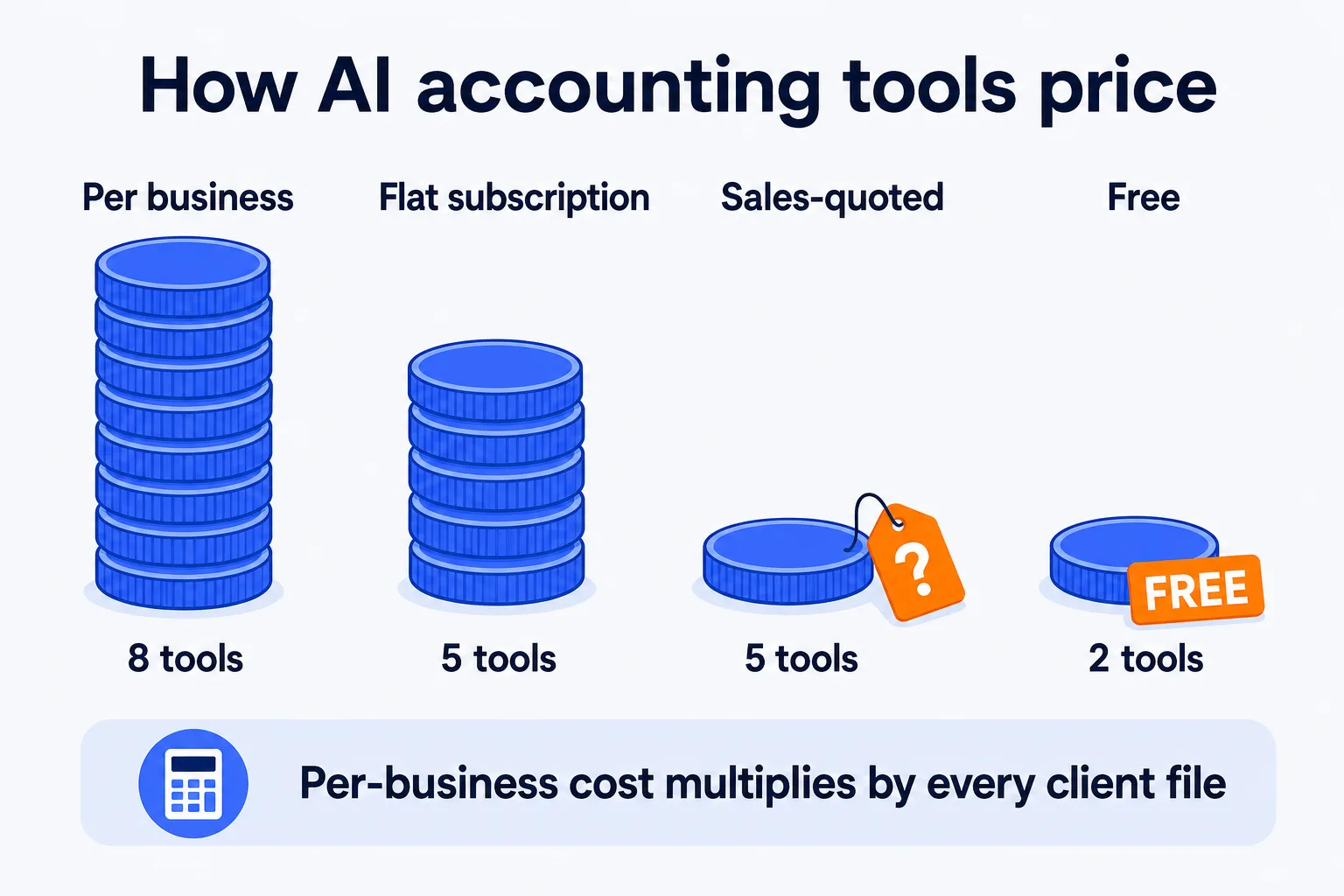
Breakdown of how 20 AI bookkeeping tools price: eight per business, five flat subscription, five sales-quoted, and two free, with a note that per-business cost multiplies by client count

Geography narrows the list more than features do

The tools making the strongest automation claims are mostly US-only. Digits, Puzzle, Kick, Zeni, Truewind, and Intuit Assist all limit availability to US-based entities. If your firm has clients in the UK, Australia, Canada, or the EU, that group is off the table before you compare a single feature.

What is left for a firm working outside the US is the established international ledgers, QuickBooks Online, Xero, Zoho Books, Sage Intacct, plus a couple of the AI-native tools that went multi-region: Booke covers the US, UK, Canada, and Australia, and Botkeeper serves firms globally. So the practical shortlist for a non-US firm is short, and it leans on the ledgers that added AI rather than the ledgers built around it. Worth knowing before a demo of a tool your clients cannot legally run on.

Best AI bookkeeping for a single business

If you are choosing software for one company, the per-business tools are exactly where you should look, because the multiplication problem never applies to you.

QuickBooks Online is the default for good reasons: it starts at about $38 per month, covers the full cycle from bank feeds to statements, and most accountants and clients already know it. Its AI layer, Intuit Assist, is included at no extra cost and handles categorization, receipt data capture, and plain-language questions about the books. For a US business that wants AI bookkeeping without a separate subscription, that combination is hard to beat on value.

Xero starts around $25 per month and does the same core jobs with a cleaner interface and deeper share in the UK, Australia, and New Zealand. If your accountant works in Xero, follow them into it. Zoho Books is the pick for a micro business watching every dollar: it has a permanently free tier for companies under $50k in annual revenue, then paid tiers that add multi-currency and inventory.

For an AI-native ledger rather than an established one with AI added, Digits starts at $65 per month and runs an autonomous general ledger that categorizes and reconciles with very little manual input. It replaces QuickBooks rather than sitting on top of it, so it fits a US founder starting fresh more than one migrating a long transaction history. FreshBooks, at about $23 per month, is invoicing-first and best for freelancers and service businesses whose bookkeeping is really billing plus expenses.

Best AI bookkeeping for a multi-client firm

Here the pricing structure does the sorting. A firm wants software that prices at the practice level, not one that bills you per client file at retail.

Botkeeper is built for this: it automates categorization, reconciliation, and month-end review across a firm's whole client book, posts the high-confidence entries, and surfaces the rest for a human, with optional human support so the practice can take on more clients without adding headcount. Digits firm plans give per-client wholesale pricing with unlimited team seats, firm-level AI models trained on your own client history, and free books for the firm itself. Booke works inside QuickBooks, Xero, or Zoho Books rather than replacing them, runs daily categorization and reconciliation, chases clients for missing documents, and offers a white-label experience on its firm plan.

One option here is not a firm tool at all. If a client would rather buy an outcome than have you keep their books, Zeni pairs AI bookkeeping with a dedicated human team of a controller, bookkeeping manager, and analyst. It is a managed service the business itself buys for its own books, at a flat $494 per month, rather than something a firm resells per client file. It works only with QuickBooks Online and only for US companies. That figure looks high next to a $65 ledger, but it includes the labor, which is the honest comparison, and it is bought by founders and finance leads rather than by firms.

Best for a startup or a fast close

A few tools target the specific shape of startup finance, where the close matters more than day-to-day data entry.

Puzzle is AI-first accounting for US startups, with a free starter tier, real-time cash-burn and revenue tracking, and pricing that scales with transaction volume rather than seats. Truewind turns bank statements and workpapers into general-ledger-ready journal entries and reconciliations, sitting on top of QuickBooks, Sage Intacct, NetSuite, or Xero to speed up the month-end close for the firms that serve startups. It is sales-quoted and US-only. Kick is the pick for a founder with several entities: per-user pricing, multiple companies under one subscription, and automatic deduction-finding.

For mid-market finance teams outgrowing a small-business ledger, DualEntry and Sage Intacct move into ERP territory with multi-entity consolidation and multi-currency. Both are quoted by sales, so budget for a longer buying process and onboarding, not just a monthly fee.

Where AI bookkeeping still stops

No tool on this list removes the judgment from the job, and buying more software will not change that.

Setting up a new client's chart of accounts reflects how the business actually runs and rarely ports cleanly from another firm. Materiality calls, whether a $400 mis-coding matters this month, depend on context the software does not have. Unusual transactions, refunds, partial payments, foreign-currency quirks, intercompany loans, still need a person. And the client conversation, the "why is this bigger than last month" check-in, is the work that keeps the client. AI shrinks the high-volume, repetitive, pattern-based part of bookkeeping. It leaves the sparse, judgment-heavy part with you. A stack that respects that line saves real hours. One sold on replacing the second part disappoints. The hub guide covers what AI bookkeeping automates and where it still fails in more depth.

How to choose in one pass

Answer three questions in order and the list narrows fast. Where are your clients? Non-US rules out most of the AI-native tools before anything else. How many sets of books? One company means the per-business tools are fine; many clients means you want firm or flat pricing, not a retail price times your client count. What is the bottleneck? Day-to-day categorization points to Booke, Botkeeper, or an AI-native ledger; a slow close points to Truewind or Digits Pro; wanting the work done for you points to Zeni.

If you would rather not run the comparison by hand, the matchmaker quiz narrows the tools we track down to the handful that fit your size, ledger, and location in a few minutes. Either way, the rule holds: check how the price scales before you fall for the number on the pricing page.

Common questions

What is the best AI bookkeeping software in 2026?

There is no single best. For a US small business, QuickBooks Online with the included Intuit Assist, or an AI-native ledger like Digits, covers most needs. For a firm running many clients, the tools that price at the practice level, Botkeeper, Digits firm plans, and Booke, cost less than per-business software multiplied across your client list. For a non-US firm, the practical choices are the established ledgers plus Booke or Botkeeper.

How much does AI bookkeeping software cost?

Published entry prices range from free (Wave, Zoho Books' micro tier, Intuit Assist inside QuickBooks) to about $494 per month for a managed service like Zeni. Most self-serve ledgers sit between $25 and $130 per month per business. Five tools, including Truewind, Sage Intacct, and NetSuite, publish no price and quote by sales call. The figure that matters for a firm is whether it is charged per business or per practice.

Does AI bookkeeping replace a bookkeeper?

No. These tools automate categorization, reconciliation, and document capture, and they draft entries for review. A person still sets up the chart of accounts, makes materiality calls, handles unusual transactions, and talks to the client. The realistic gain is fewer hours on repetitive data work, not a replaced role.

Can AI bookkeeping software work with QuickBooks or Xero?

Many tools do. Booke, Botkeeper, Truewind, and Intuit Assist work inside or on top of QuickBooks Online, Xero, or both. Others, like Digits and Puzzle, are standalone ledgers that replace QuickBooks rather than sync with it, so check whether a tool overlays your ledger or asks you to move off it.

What is the cheapest AI bookkeeping software for a firm with many clients?

Not the one with the lowest per-business price. A tool at $65 per business becomes $1,950 a month across 30 clients at retail. Firm-level pricing changes that: Digits firm plans start around $35 per client wholesale, Botkeeper prices at the practice level, and Booke offers a custom firm quote. Compare those against a per-business price multiplied by your client count, not against the sticker.

Find the right AI tools for your firm

Seven questions, two minutes, a short list of the five tools that fit your firm best. Your results, instantly. No sign-up needed.

Take the matchmaker

Tools referenced in this article

More articles

Last updated 2026-07-01. Tool comparisons are based on vendor-published specs. See our methodology.