CurateSuite
Comparison9 min read

Best Dext Alternatives for Receipt and Invoice Capture

Dext quotes its price by sales call and offers no permanent free tier. Of six catalog alternatives, only Nanonets and Veryfi give you real free access; the rest gate real use behind a paid plan or a trial that expires.

By CurateSuite
Overhead flat-lay of a bookkeeper's desk with a smartphone mid-scan of a receipt above a fanned row of six blank document trays representing different capture tools, on a warm off-white surface with brand blue and orange accents

Two things push firms away from Dext before they have even compared what else is out there. Dext no longer publishes a price list, so the first real number a firm sees comes from a sales call. And Dext offers a free trial, not a free tier, so once that trial ends, the meter is running whether or not the firm has decided the tool is worth it. Neither problem is unique to Dext among document capture tools, which is the part worth knowing before you switch: of the six catalog tools built to do the same job, only two, Nanonets and Veryfi, give you a permanent free tier rather than a countdown. The other four, AutoEntry, Hubdoc, Eazycapture, and Rossum, all gate real use behind a paid plan or a trial that expires, the exact friction that likely sent you looking in the first place.

That does not make Dext the wrong tool. It means the alternative you pick should solve the specific friction you have, not just swap one flavor of it for another. This article sorts the field that way: which tools publish a real price, which ones let you run documents through for free indefinitely, and which ones reach ledgers Dext does not touch at all. For the full category, including receipt-only tools and bank statement parsing, see the OCR and document capture guide for accountants, the hub this article sits under.

The short answer

  • Want to try extraction quality before committing a card: Nanonets starts with $200 in free usage credits and stays free at low volume; Veryfi covers up to 100 documents a month at no cost indefinitely, not just during a trial window.
  • Want a published price instead of a sales call: AutoEntry starts at $13 a month for 50 credits, listed on its pricing page with no quote required.
  • Already paying for Xero and want capture bundled in: Hubdoc is included free on any paid Xero plan, or about $12 a month per business standalone.
  • UK practice on Xero or QuickBooks: Eazycapture prices per client from about GBP 7 a month, with unlimited team seats included.
  • Ledger is SAP, NetSuite, Oracle, or Microsoft Dynamics, not QuickBooks, Xero, or Sage: Rossum is the one tool here built for enterprise ERP routing, starting at $18,000 a year.
  • Want extraction built into your own app or client portal: Veryfi is API and SDK only; Nanonets also exposes a full API for teams that want to wire extraction into their own tooling rather than rely solely on its built-in workflow UI.

Why firms go looking for a Dext alternative

Three specific frictions come up more than any complaint about extraction accuracy, which by most vendor accounts is close across the leading tools in this category:

Pricing you cannot see without talking to sales. Dext dropped its published price list; plans are now quoted around document volume and user count. A firm comparing tools on a Friday afternoon cannot get a number without booking a call, which rules Dext out of a quick side-by-side even for firms that would otherwise be happy to pay.

No permanent free tier. Dext's free trial ends. There is no ceiling under which a solo bookkeeper can keep running documents through for free indefinitely, the way Nanonets and Veryfi allow.

Ledger reach stops at QuickBooks, Xero, Sage, and Excel. That covers most small and mid-sized practices, but not a firm with clients on FreeAgent, KashFlow, ClearBooks, NetSuite, SAP, or Microsoft Dynamics. Dext simply does not connect there.

Match your actual friction to the section below rather than picking the first name that sounds familiar. A firm annoyed by Dext's hidden pricing gains nothing by moving to Rossum, which is priced even less transparently at the top end. A firm that wants ERP reach gains nothing from AutoEntry, which covers small-business ledgers only, the same category Dext is limited to.

Tools with a genuine free tier: Nanonets and Veryfi
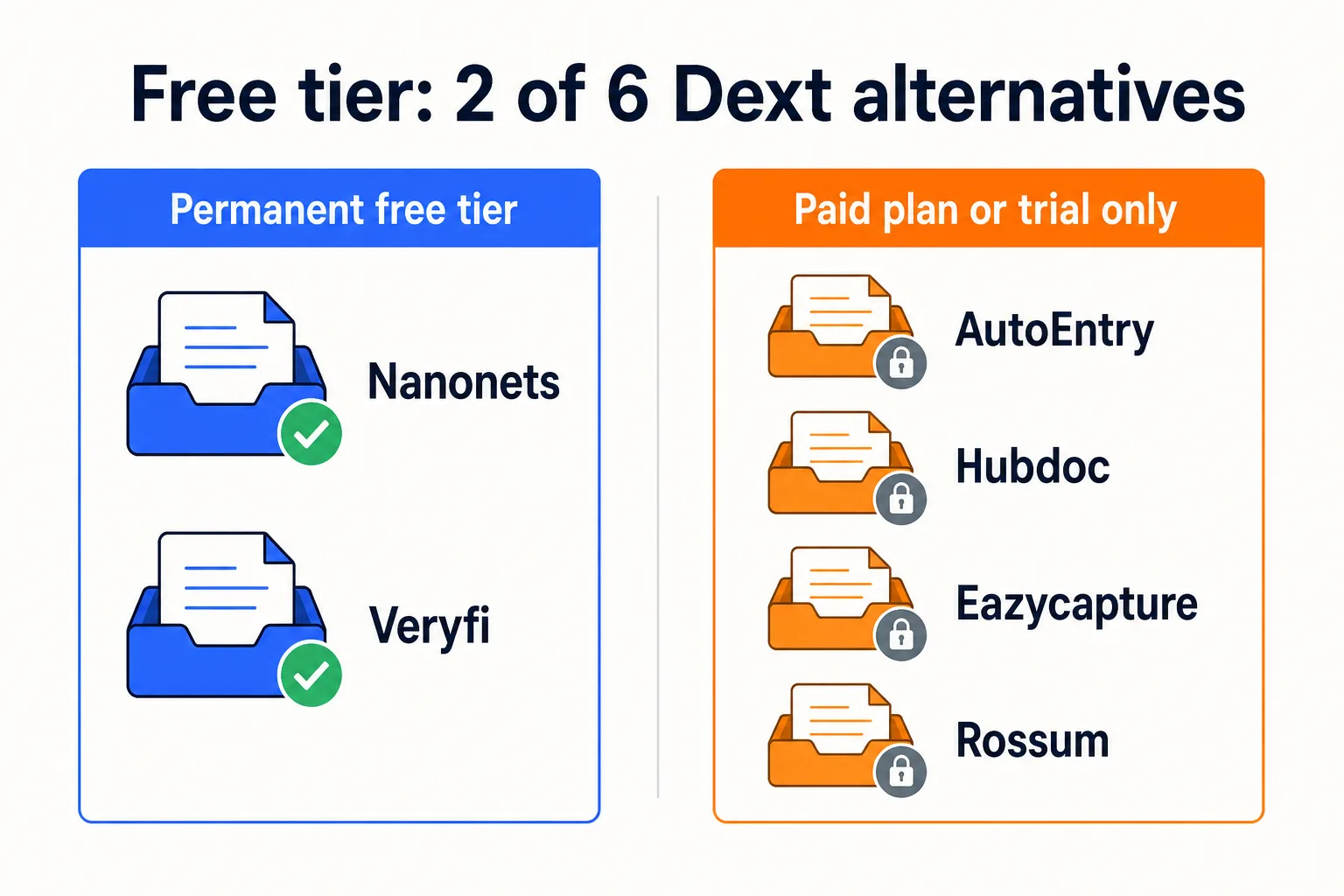
Six Dext alternatives split by free access: Nanonets and Veryfi offer a permanent free tier, while AutoEntry, Hubdoc, Eazycapture, and Rossum require a paid plan or a time-limited trial

Nanonets reads invoices, receipts, bank statements, and other document types, then routes the extracted data into QuickBooks Online, Xero, Sage Intacct, NetSuite, SAP, or Microsoft Dynamics. The Starter tier is free, backed by $200 in usage credits, and stays usable after the credits run out because runs are billed individually from about $0.02 for a simple extraction to $0.30 for a complex one. There is no forced upgrade date. A firm can sit on the free tier for months at low volume and only pay for what it actually processes.

Veryfi works the same way from the other direction: it is an API and SDK, not a ready-made inbox, so a firm or software team sends it a document image and gets back structured JSON. The free tier covers up to 100 documents a month, permanently, across 38 languages. Past that, the Starter tier runs $0.16 per invoice against a $500 monthly minimum. Veryfi fits a firm or vendor that wants to build the extraction into an existing app or client portal rather than log into a separate capture tool.

Veryfi asks for development resource to get any value out of it at all, since the API and SDK are the only interface. Nanonets is more configurable than that: it has its own workflow platform, though a firm still needs to set up that configuration rather than open a polished, ready-to-use mobile app and browser extension the way Dext, AutoEntry, or Hubdoc offer a non-technical bookkeeper.

Tools with published, no-call pricing: AutoEntry, Hubdoc, Eazycapture

If the friction is Dext's custom quote rather than the lack of a free tier, three tools list a real number on their own pricing pages.

AutoEntry charges by credit, one credit per document, from $13 a month for 50 credits up to $469 for 2,500. Every tier includes unlimited users and a 90-day credit rollover, so the bill tracks document volume rather than headcount. It connects to Sage, Xero, QuickBooks, FreeAgent, KashFlow, and ClearBooks, a wider small-business ledger list than Dext covers, though it does not add the AI coding suggestions Dext layers on top of extraction.

Hubdoc is the cheapest option on this list for firms already committed to Xero: it ships free on any paid Xero plan. Off Xero, standalone pricing runs about $12 a month per business, and it also connects to QuickBooks. What it will not do is line-item AI coding on complex invoices; firms with that need are generally better served by Dext or AutoEntry, so a supplier invoice with a dozen taxed lines is not its strength.

Eazycapture is built specifically for UK practices, pricing per client rather than per user, from about GBP 7 a month on annual billing with unlimited team members bundled in. It connects to Xero and QuickBooks, making it a fit for a UK-only book of clients rather than a firm operating across regions.

Built for enterprise ERP reach: Rossum

Rossum is the exception to nearly everything else on this list. It is not aimed at solo bookkeepers or small practices at all: it processes invoices and purchase orders at volume for finance teams running SAP, NetSuite, Oracle, or Microsoft Dynamics, matching extracted data against a master vendor list and routing documents through an approval workflow before anything posts. Starting price is $18,000 a year on the Starter tier, which puts it well outside small-firm budgets and squarely in mid-market and enterprise territory.

If your reason for leaving Dext is that it does not reach the ERP your larger clients run on, Rossum is the one tool in this group built for that job. If your reason is price transparency or a free tier, Rossum solves neither; its own pricing sits behind a quote for anything past the Starter tier.

Pricing and reach at a glance

ToolPricing modelFree tierLedgers or ERP reachBest fit
DextCustom quoteNo (trial only)QuickBooks, Xero, Sage, ExcelComplex, multi-currency invoices with AI coding
AutoEntryPublished, per creditNo (trial only)Sage, Xero, QuickBooks, FreeAgent, KashFlow, ClearBooksUneven volume, unlimited users
HubdocPublished, flatNo (free with paid Xero)Xero, QuickBooksSimple bills, Xero-committed firms
NanonetsPublished, per runYesQuickBooks Online, Xero, Sage Intacct, NetSuite, SAP, Microsoft DynamicsConfigurable workflows, ERP reach on a budget
VeryfiPublished, per documentYesAPI-first, integrates into QuickBooks and custom appsDevelopers embedding extraction
RossumCustom quote (Starter published)NoSAP, NetSuite, Oracle, Microsoft Dynamics, QuickBooks, SageHigh-volume ERP finance teams
EazycapturePublished, per clientNo (trial only)Xero, QuickBooksUK practices

Figures reflect what each vendor publishes as of this writing. Confirm current pricing on the vendor's own page before committing, since custom-quoted and volume-based tiers move as vendors update plans.

How to choose without trading one friction for another

Start by naming the actual complaint. If it is the sales call, cross Rossum off the list too; its higher tiers hide behind the same kind of quote. If it is the lack of a free tier, only Nanonets and Veryfi solve that, and both ask for development time in return. If it is ledger reach, the answer depends entirely on which ledger: AutoEntry covers the widest small-business set, while Rossum is the only one built for enterprise ERPs.

Volume shape matters after that. A firm with light, unpredictable document counts gets more from a usage-based tool like Nanonets, where the bill tracks actual runs, than from a fixed monthly credit block that goes unused some months. A firm with steady, high volume across many clients does better on a flat or per-client model like Hubdoc or Eazycapture, where the price does not move with document count.

If line-item AI coding on messy invoices was the actual reason Dext was worth its price, check that the replacement offers it before switching on cost alone. AutoEntry, Nanonets, and Eazycapture all extract line items; Hubdoc does not do line-item AI coding, so a supplier invoice with a dozen taxed lines is not its strength. For the fuller line-item breakdown across the category, see the guide to invoice OCR software, and for how captured documents flow into a firm's broader filing and retrieval system, see AI document management for accounting firms.

Whichever direction the answer points, check the document capture and extraction category for the current tool list and specs before signing an annual contract, since pricing and integration lists shift as vendors update plans. The site's methodology page explains how these comparisons are built from vendor-published specifications rather than hands-on testing.

Common questions

Why do firms look for a Dext alternative in the first place?

Mostly one of three reasons: Dext no longer lists a public price, so comparing costs means booking a sales call; its free access is a time-limited trial rather than a permanent tier; and it only connects to QuickBooks, Xero, Sage, and Excel, which leaves out firms with clients on other platforms. None of these are functionality complaints about extraction accuracy, which is broadly comparable across the leading tools in this category.

Which Dext alternative has a permanent free tier?

Nanonets and Veryfi, among the six catalog tools compared here. Nanonets starts with $200 in free usage credits and continues at low, usage-based rates after that. Veryfi covers up to 100 documents a month for free, indefinitely, not just during an onboarding window. AutoEntry, Hubdoc, Eazycapture, and Rossum all require a paid plan once any trial period ends.

Is there a Dext alternative that reaches SAP or NetSuite?

Rossum is the one built for that. It connects to SAP, NetSuite, Oracle, and Microsoft Dynamics as well as QuickBooks and Sage, and adds purchase order matching and approval routing on top of extraction. It starts at $18,000 a year, which puts it in a different budget bracket than the small-business tools in this comparison. Nanonets also reaches NetSuite, SAP, and Microsoft Dynamics at a much lower, usage-based price, though without Rossum's approval workflow.

Does switching from Dext mean giving up AI coding suggestions?

Not entirely. AutoEntry, Nanonets, and Eazycapture all extract line-item detail that a firm can code from, though none layers on the same coding-suggestion engine Dext built around repeat suppliers. Hubdoc does not do line-item AI coding, so a firm relying on Dext for line-by-line invoice coding will lose that specific capability moving to Hubdoc.

Can a firm run more than one document capture tool at once?

Yes, and many do. A common split is a free or low-cost tool like Hubdoc for simple, low-volume clients, paired with a heavier tool like Dext, AutoEntry, or Nanonets for the clients with complex, high-volume, or multi-currency documents. Running two tools costs more in subscriptions but usually less than paying premium per-document rates across every client regardless of how simple their documents are.

If you would rather skip the side-by-side entirely, the CurateSuite matchmaker takes a few questions about your firm's document volume and ledger and returns the tools that fit, no email required to see the results.

Find the right AI tools for your firm

Seven questions, two minutes, a short list of the five tools that fit your firm best. Your results, instantly. No sign-up needed.

Take the matchmaker

Tools referenced in this article

More articles

Last updated 2026-07-17. Tool comparisons are based on vendor-published specs. See our methodology.