CurateSuite
List9 min read

Virtual Accounting Assistants: AI Options Compared

Virtual accounting assistant search results split into four unrelated products: a ledger copilot, a managed bookkeeping team, a practice-wide research assistant, and a single-workflow agent. Here is which one matches what you need handled.

By CurateSuite
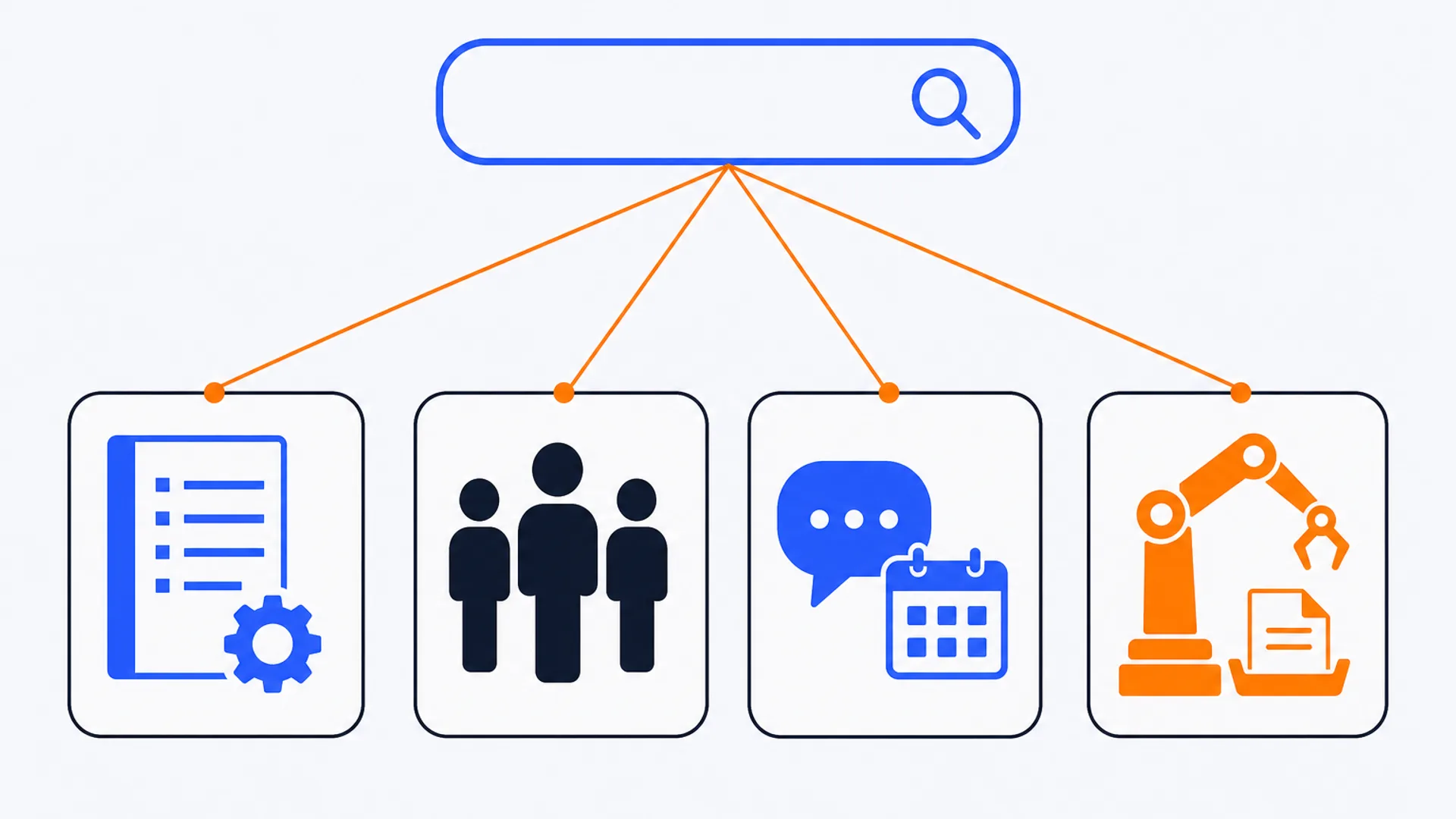
Flat editorial illustration in brand blue, orange, and deep slate on off-white: a single search bar icon at the top labeled with a magnifying glass fans out into four distinct destination icons below it, a ledger page with a gear, a small team of three human figures, a chat bubble beside a calendar, and a robot arm over a document tray, representing four unrelated products hiding under one search term

Type "virtual accounting assistant" into a search bar and the results are not one product category. They are four, and they solve completely different problems. One result is an AI feature bolted onto the ledger you already use. Another is a human bookkeeping team with AI doing the drafting behind the scenes. A third joins your client meetings and drafts your emails. A fourth is software that runs a single workflow, usually accounts payable, from start to finish with no assistant framing at all, yet still turns up under the same search.

That matters because the four jobs are not interchangeable, and comparing them on a single feature table produces a confusing shortlist. The best starting point is the broader hub guide, Best AI bookkeeping assistants in 2026, which sorts 20 tools in the core ledger and bookkeeping catalog by how much of the work a documented human actually does. This article takes a step back from that and answers a narrower question first: which of the four jobs behind the phrase "virtual accounting assistant" is the one you actually want, before you start comparing individual tools inside it.

The four things people mean by "virtual accounting assistant"

None of these four is more correct than the others. They just do different jobs.

  1. A copilot built into the ledger you already use. It categorizes transactions, reads receipts, and answers questions about the books, inside the software you log into every day.
  2. A managed bookkeeping team with AI doing the drafting. A person, either a vendor's staff or your own accountant, reviews or does part of the work; the AI just makes that person faster.
  3. A practice-wide assistant for meetings, email, and research. It does not touch the ledger at all. It sits across your calls, your inbox, and your research queries.
  4. An autonomous agent that runs one workflow end to end. Usually accounts payable: reading invoices, coding them, routing approvals, and posting, without a person in the loop for the routine cases.

A copilot built into the ledger you already use

This is the version most people actually find first, because it comes free with software they already own. Intuit Assist is the clearest example: it is not a separate purchase, it is the AI layer inside QuickBooks Online, and it categorizes transactions, pulls data off receipts, drafts overdue-invoice reminders, and answers plain-language questions about the books at no extra cost on top of a QBO subscription that starts around $20 a month.

Xero takes a more conservative approach: AI-assisted bank-feed matching and transaction categorization run quietly in the background, and a separate natural-language assistant called Just Ask answers questions about the books, all included in every plan from $25 a month. Two newer, AI-native ledgers built for US startups take the same idea further: Digits runs an Autonomous General Ledger that categorizes and reconciles with very little human touch and includes an "Ask Digits" assistant from $65 a month, while Puzzle does the same job with a free starter tier under $20,000 in transaction volume before scaling up to $150 a month.

The tell for this category is simple: the assistant only exists inside the ledger. If you are not already on that ledger, the assistant is not available to you at any price, because it is not sold separately from the accounting platform underneath it. That single fact rules out most of this group immediately if you have not chosen a ledger yet, and rules in exactly one of them if you have.

A managed bookkeeping team with AI doing the drafting

This job looks the least like software and the most like hiring someone, because that is closer to what it is. Zeni, Botkeeper, Truewind, and Booke, all part of the core ledger and bookkeeping catalog, each document a human doing or checking part of the work rather than an AI running unsupervised. Zeni pairs its AI categorization with a dedicated human team and prices around $494 to $719 a month because the price includes labor, not just software. Botkeeper automates the coding for accounting firms and adds vendor support staff as an optional layer. Truewind drafts entries with AI and routes them to a person, usually your own accountant, before anything posts. Booke works the same ledger-first way but posts routine categorization and reconciliation automatically, only flagging the transactions it's unsure about for a person to check.

The full breakdown of how much human involvement each of the four actually documents, and where the other 16 tools in the catalog fall on that scale, is the subject of the hub guide linked above. If what you actually want is to stop touching the books entirely rather than pick a specific tool, start there.
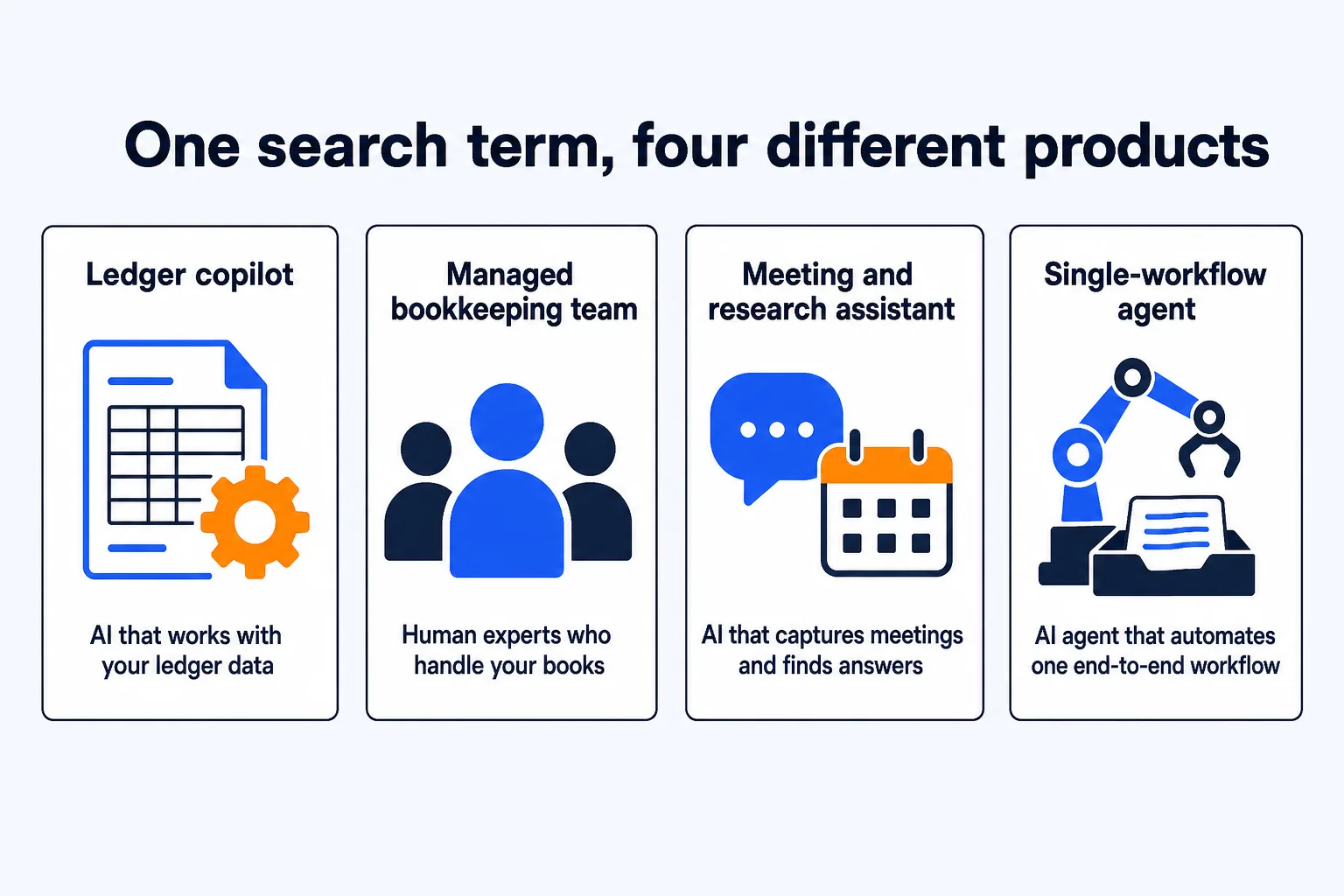
Four unrelated products that all surface under a virtual accounting assistant search: a ledger copilot inside software you already own, a managed bookkeeping team with AI drafting behind a person, a practice-wide assistant for meetings and research, and an autonomous agent running accounts payable without an assistant label at all

A practice-wide assistant for meetings, email, and research

This job never touches the general ledger. It sits across the parts of running a firm that happen outside the books: calls with clients, the inbox, and research questions.

Ping Assistant is built specifically for accounting and advisory firms. It joins client meetings on Zoom, Google Meet, and Teams, transcribes phone calls through Dialpad and OpenPhone, drafts follow-up emails, and pushes notes and action items into practice management tools like Karbon or Financial Cents. Pricing starts at $28 per user a month on annual billing, and the top Scaling tier adds a memory layer that is searchable across a client's meetings, emails, and notes.

Spark AI, from Rightworks, does a different half of the same job. It handles research, document summarization, and drafting inside Rightworks' secure hosted environment, aimed at firms that want staff using AI on client material without pasting it into a public chatbot. It is not sold on its own; it comes bundled with Rightworks Cloud Hosting from about $85 per user a month, so the real comparison for a firm not already on Rightworks is whether the hosting platform itself is worth adopting.

Both of these are genuinely "assistant" in the plain sense: something that takes work off a person's desk across the parts of the job that are not bookkeeping. Neither one categorizes a transaction.

An agent that runs one workflow without you

The fourth group rarely calls itself an assistant at all. It is usually marketed as an "AI agent," and it still turns up under virtual-accounting-assistant searches because the underlying pitch, a task run without a person doing it, is the same one people are searching for.

Numra builds AI agents scoped to a single accounts payable workflow: reading invoices, coding them, routing approvals, and posting to the ledger under plain-English rules, with monitoring and an audit trail rather than a person checking each line. Vic.ai runs the same idea at enterprise scale, processing invoices, matching purchase orders, and routing approvals for finance teams on ERPs like SAP, NetSuite, or Oracle with minimal human touch. Glean.ai narrows the same pattern further, coding bills with AI and then benchmarking vendor pricing so a finance team sees whether an approved bill should have been approved in the first place.

None of these three describe a person drafting or checking the routine case. That is the real difference from the managed-bookkeeping group above: there, a human is part of the documented workflow. Here, the workflow is built to run without one, and a person only steps in on exceptions the rules do not cover.

Which of the four do you actually need?

Skip the feature comparisons until you can answer this:

  • Do you already have a ledger you are happy with? If yes, check whether it already includes an AI copilot at no extra cost before buying anything separate.
  • Do you want a person removed from bookkeeping entirely, or just faster? Removed entirely points toward a managed service. Faster, with you still approving, points toward Truewind- or Booke-style drafting.
  • Is the bottleneck inside the books, or around them? Meetings, follow-up emails, and research queries are a different job from categorizing transactions, and no ledger copilot touches that side of the practice.
  • Is there one specific workflow, like accounts payable, eating disproportionate time? That is the case where a single-purpose agent earns its keep, rather than a general assistant that tries to cover everything at once.

Answer those four honestly and the shortlist narrows itself before you have compared a single price.

Is a virtual accounting assistant the same as a virtual assistant for a CPA firm?

Not quite, and the overlap is where a lot of the search confusion starts. "Virtual assistant for a CPA firm" more often points toward the practice-wide category above, an assistant that handles meetings, email, and research rather than the books themselves, or toward a human virtual staffing arrangement that is not a software product at all. "Virtual accounting assistant" pulls in the ledger copilots and the bookkeeping-specific tools as well. If your firm's actual need is administrative and client-facing rather than bookkeeping, start with the meeting and research assistants, not the ledger tools.

Does a virtual accounting assistant replace a bookkeeper?

Only the managed-service tier gets close, and even then a firm's own accountant typically still handles tax filing, advisory conversations, and unusual transactions unless those are purchased as separate add-ons. The ledger copilots and the single-workflow agents both still need someone to set up the chart of accounts, handle exceptions, and make the judgment calls the software flags rather than resolves. The realistic gain across all four groups is fewer hours spent on repetitive entry and coding, not a role that disappears.

If you would rather answer a few questions than sort through four product categories by hand, the matchmaker quiz narrows the tools we track down to the ones that fit your firm size, ledger, and how much of the work you actually want off your desk.

Common questions

What is a virtual accounting assistant?

It is not one product. The phrase covers at least four different things: an AI feature built into a ledger like QuickBooks Online or Xero, a managed bookkeeping service where a human team uses AI to work faster, a practice-wide assistant for meetings and research that never touches the books, and an autonomous agent that runs a single workflow like accounts payable without a person in the loop.

Is a virtual accounting assistant the same as a virtual bookkeeper?

Only sometimes. A virtual bookkeeper usually implies a person, in-house or outsourced, doing the bookkeeping. That maps closest to the managed-service group, Zeni and Botkeeper among them, where a documented human team or support staff sits behind the AI. A ledger copilot like Intuit Assist has no person behind it at all; it is a feature, not a colleague.

How much does a virtual accounting assistant cost?

It ranges from free to over $700 a month because the category spans software and staffing. Ledger copilots like Intuit Assist and Xero's Just Ask are included in a subscription that already starts around $20 to $25 a month. Practice-wide assistants like Ping Assistant start at $28 per user a month. A fully managed bookkeeping service like Zeni starts around $494 a month because the price includes a human team, not just software.

Is a virtual assistant for a CPA firm the same as a virtual accounting assistant?

They overlap but are not identical. "Virtual assistant for a CPA firm" leans toward administrative and client-facing help, meetings, email, and research, which is the practice-wide category covered above (Ping Assistant, Spark AI) rather than the ledger-focused tools. If a firm's real bottleneck is client communication rather than bookkeeping, that is the group to start with.

Does a virtual accounting assistant work with QuickBooks or Xero?

Most do, but which one depends on the job. Intuit Assist only works inside QuickBooks Online, and Xero's Just Ask only works inside Xero. Truewind and Booke sit on top of QuickBooks Online, Xero, or both. Digits and Puzzle are standalone ledgers built to replace QuickBooks rather than connect to it. Ping Assistant and Spark AI do not touch the ledger at all; they connect to practice management tools and communication apps instead.

Find the right AI tools for your firm

Seven questions, two minutes, a short list of the five tools that fit your firm best. Your results, instantly. No sign-up needed.

Take the matchmaker

Tools referenced in this article

More articles

Last updated 2026-07-09. Tool comparisons are based on vendor-published specs. See our methodology.